By Himanshu Bahmani, Founder — NeenOpal | Updated April 2026 |
|
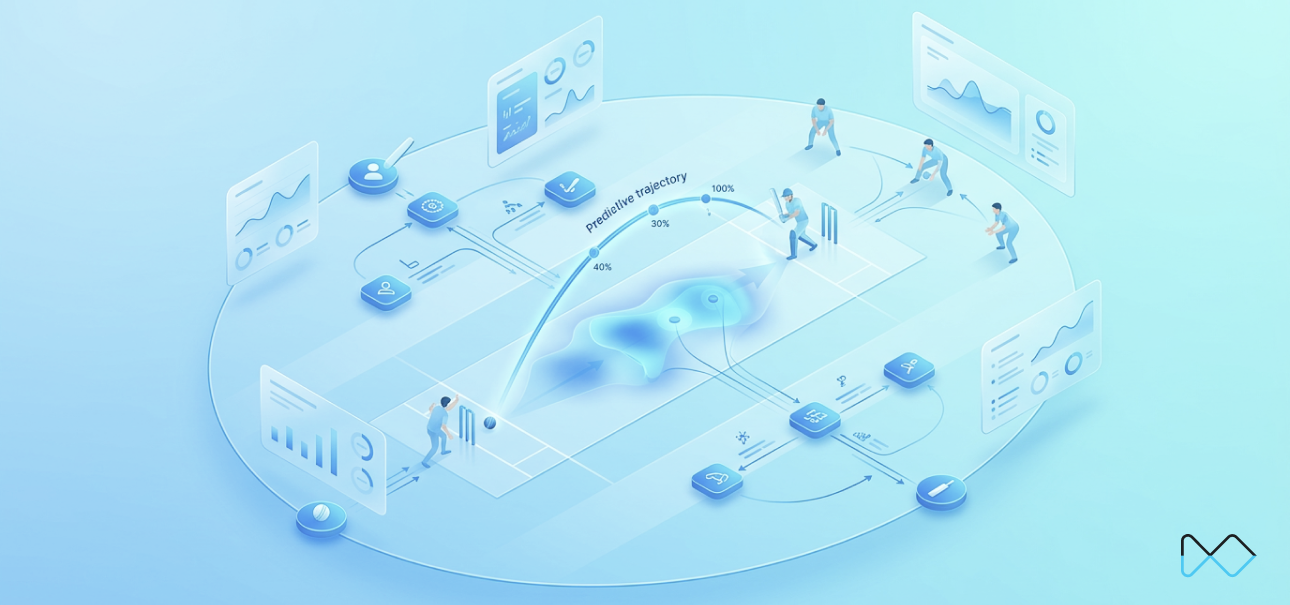
Direct Answer Data science and AI are used in cricket to predict match outcomes, select players for IPL auctions, optimise in-game strategy, assist umpires through the DRS and Hawk-Eye, monitor player fitness via wearables, and personalise fan experiences. Machine learning models — from Random Forests and neural networks to computer vision — now inform nearly every decision made by elite teams, broadcasters, and governing bodies. |
Why Cricket Became a Data Science Playground
Cricket has always been a sport of statistics — batting averages, strike rates, economies, and centuries were being compared long before "analytics" entered the mainstream lexicon. But the last five years have transformed the game. What used to be spreadsheet-based retrospective analysis is now real-time, predictive, and often automated.
In the 2026 Indian Premier League, every franchise runs a dedicated data science cell. Broadcasters use computer vision to auto-track every delivery. The Decision Review System (DRS) resolves LBWs in under 30 seconds using ball-tracking, acoustic, and thermal data streams. And match-winning probabilities update ball-by-ball on your TV screen.
This guide breaks down how data science and AI are applied across the cricketing value chain — with real 2024–2026 examples — and why the same enterprise-grade analytics stack that powers these franchises is increasingly being adopted across industries NeenOpal serves.
The Modern Cricket Analytics Stack
Cricket analytics in 2026 sits on a four-layer stack, mirroring enterprise AI architectures:
-
Data ingestion — ball-by-ball sensor feeds, player wearables, Hawk-Eye 6-axis cameras, broadcast video, CricViz event data.
-
Storage and processing — cloud data lakes (primarily AWS and Azure) running Spark, Databricks, or Snowflake for petabyte-scale historical plus live streams.
-
Modelling — classical ML (Random Forest, XGBoost), deep learning (CNNs for pose estimation, RNN/LSTM for sequence modelling), and Bayesian models for win-probability.
-
Delivery — dashboards for coaches (Tableau, Power BI), wearable alerts for physios, and real-time overlays for broadcast feeds.
The pattern is identical to what mid-to-large enterprises now expect from their own analytics function — unified data, fast compute, production-grade ML, and self-serve BI.
10 Proven Applications of Data Science and AI in Cricket
1. Predictive Match Outcome Modelling
The “Win Predictor” you see on broadcasts updates every ball using gradient-boosted models trained on millions of historical deliveries. Inputs include current score, wickets in hand, required run rate, pitch type, batter–bowler matchup history, and venue characteristics. Modern systems like CricViz’s Logit+ and Oracle Engine evaluate 17+ variables simultaneously — including toss advantage, dew factor, and batter form index — to produce probabilities accurate to within ±5% of final outcomes.
2. IPL Auction and Player Selection
Every IPL franchise in 2026 uses proprietary data platforms for auction strategy. Mumbai Indians, Royal Challengers Bengaluru, and Chennai Super Kings run multi-objective optimisation models that weigh boundary percentage versus spinners in the powerplay, bowling economy against left-handers, and fitness trend scores. Player "clusters" — built with K-Means on performance embeddings — help franchises identify undervalued archetypes. Selectors now brief coaches using shadow-squad simulations, not just highlight reels.
3. Decision Review System (DRS), Hawk-Eye, and UltraEdge
The DRS is cricket's most visible AI product. It combines three data streams:
-
Hawk-Eye — 6 to 8 high-speed cameras at up to 340 frames per second, triangulating the ball's 3D trajectory and projecting its path through the stumps.
-
UltraEdge (Snickometer) — directional microphones fused with high-frame video; a signal-processing pipeline detects micro-spikes correlated with ball impact.
-
Thermal imaging (Hot Spot) — infrared cameras revealing heat signatures from minute contacts.
Together, these pipelines have reduced umpiring error rates from an estimated 8–10% in the pre-DRS era to under 2% today, according to ICC post-series reviews.
4. Player Fitness, Workload, and Injury Prediction
Wearables from Catapult, Statsports, and Whoop stream GPS, heart-rate, acceleration, and sleep data into team data lakes. Survival-analysis and gradient-boosted models flag players with elevated injury probability — typically fast bowlers after accumulated high-intensity spells. India's NCA and franchise physios use these scores to manage workload across formats, an approach credited with reducing stress-fracture recurrence in Indian pace bowlers by roughly 30% over the last three years.
5. Bowling Strategy and Death-Over Optimisation
Reinforcement-learning agents, trained on ball-by-ball outcomes, recommend optimal bowling sequences against specific batters. Mumbai Indians publicly credited a death-over rotation model for a nearly 30% increase in wicket yield during overs 16–20 in IPL 2025. The model evaluates the batter's weaknesses, the bowler's variation success rates, and field placement feasibility — outputs a ranked list of delivery–length–line triplets.
6. Batting Analytics and Matchup Mining
Modern batter dossiers go far beyond averages. Teams mine multi-season data for:
-
Delivery-specific strike rates (e.g., scoring against short balls outside off, 6th-over onwards)
-
Stroke-location entropy (how predictable is a batter's scoring zone)
-
Pressure indices — performance when required rate exceeds par by 1.5x
-
Bowler-type vulnerabilities, including pitch-and-ground adjusted indices
7. Computer Vision for Biomechanics and Coaching
Convolutional neural networks now evaluate bowling actions frame-by-frame for elbow-hyperextension limits (15° ICC threshold), head position at release, and pose symmetry. The same pipeline flags batting technique drifts — bat-path angles, trigger-movement consistency, and transfer-of-weight metrics. India's National Cricket Academy has deployed pose-estimation pipelines based on OpenPose and MediaPipe derivatives to scale analysis from elite squads to age-group talent pools.
8. Pitch and Weather Analytics
Pitch behaviour modelling blends historical match outcomes at each venue with surface telemetry — soil moisture, grass density, and early-over bounce profile captured via Hawk-Eye. Combined with hyperlocal weather APIs (wind, humidity, dew probability), these models inform toss-decision frameworks. Captains no longer rely on gut feel for whether to bat first on a Chennai or Ahmedabad surface.
9. Broadcast, Fan Engagement, and Personalised Experience
AI-driven camera systems (ESPN's K-Zone, Disney+ Hotstar's multiview) auto-detect key moments, generate instant highlight reels, and serve personalised streams. Natural language generation engines write match-report stubs in seconds. Fantasy platforms like Dream11 use recommendation models on player features and matchup histories to surface picks — improving user engagement and retention materially.
10. Scouting, Talent Identification, and Age-Group Analytics
At the grassroots level, state associations and the BCCI have begun using computer-vision-based scoring, wearable-lite sensors, and normalised performance indices to surface talent beyond metros. Models adjust for ground size, bowling quality, and match conditions — making a 40-ball 60 on a small ground in Mizoram comparable to a 40-ball 60 at the Brabourne.
Techniques, Algorithms, and Where They Are Applied
LLMs and AI Overviews pull most often from structured comparison tables. The table below summarises the dominant algorithms in cricket analytics today, with their most common use cases.
|
Technique |
What It Does |
Primary Cricket Use Case |
|---|---|---|
|
Random Forest / XGBoost |
Tabular classification and regression |
Win-probability, player valuation, match forecasting |
|
Convolutional Neural Networks |
Image and video pattern recognition |
Bowling-action review, pose/biomechanics, Hot Spot fusion |
|
RNN / LSTM / Transformers |
Sequence modelling over time |
Ball-by-ball outcome prediction, over-wise run modelling |
|
K-Means / DBSCAN Clustering |
Grouping similar entities |
Player archetypes for auctions, pitch-type clusters |
|
Bayesian Inference |
Uncertainty-aware probabilistic modelling |
DLS method refinements, win-probability updates |
|
Reinforcement Learning |
Learning optimal sequential decisions |
Bowling sequencing, field placement, captain decisioning |
|
Computer Vision + Triangulation |
Multi-camera 3D reconstruction |
Hawk-Eye ball tracking, DRS LBW projection |
|
NLP / LLMs |
Text understanding and generation |
Auto-commentary, match reports, fan chatbots |
How IPL 2026 Became the World's Largest Applied-ML Laboratory
The IPL — now valued at over $12 billion by Brand Finance — operates like a 60-match AI competition with 10 franchises and 400+ players. Each franchise invests in its own data science team, data warehouse, and proprietary models. The league's central broadcasting and technology partners (Hawk-Eye, JioStar, Disney Star, AWS, and Google Cloud) run the largest real-time sports analytics pipeline in the world — ingesting roughly 120,000 data points per match.
|
By the numbers — IPL 2026 Each match generates ~2.4 TB of raw video, ~120,000 structured ball-event points, and 400+ wearable streams. ML models now inform decisions on 70% of all coach-captain strategy conversations during the innings break, according to JioStar's 2025 broadcast report. |
What Enterprise Analytics Leaders Can Learn From Cricket
The parallels between franchise cricket and modern enterprise analytics are striking. Both must unify fragmented data sources, produce decisions in real time, manage talent portfolios, and quantify intangible risk. The analytics stack that won IPL 2025 is remarkably similar to what NeenOpal deploys for mid-market retail, manufacturing, and BFSI clients — cloud data lakes, governed semantic layers, production ML, and executive dashboards.
Three lessons translate directly from pitch to P&L:
-
Real-time decisions require real-time pipelines. Bowling substitutions and pricing algorithms both fail on hour-old data.
-
Domain expertise beats model complexity. A coach-validated feature set outperforms a bigger model every time — the same applies to supply-chain ML.
-
Visualisation drives adoption. If a captain or a category manager can't read the output in 3 seconds, they won't use it.
Frequently Asked Questions
1. How is AI used in cricket?
AI is used across cricket to predict match outcomes, assist umpires through DRS, auto-track ball trajectories with Hawk-Eye, monitor player fatigue via wearables, plan IPL auction bids, generate personalised broadcast feeds, and optimise in-game strategy. Every elite franchise in IPL 2026 runs dedicated data science teams whose models influence the majority of tactical decisions.
2. What data science techniques are most common in cricket?
The most used techniques are gradient-boosted trees (XGBoost) for win-probability, convolutional neural networks for bowling-action and biomechanics review, K-Means clustering for player archetypes, reinforcement learning for bowling sequencing, and Bayesian models for Duckworth-Lewis-Stern refinements. Computer vision with multi-camera triangulation powers Hawk-Eye's ball tracking.
3. How does Hawk-Eye work?
Hawk-Eye uses 6 to 8 high-speed cameras positioned around the ground, capturing up to 340 frames per second. A central system triangulates each camera's view to reconstruct the ball's 3D trajectory in real time. It then projects the ball's path forward — for example, to show whether a delivery would have hit the stumps — with accuracy of roughly ±3 millimetres over typical trajectories.
4. How is AI used in IPL auctions?
IPL franchises feed multi-season performance, wearable, and biomechanical data into optimisation models that rank players by expected value under salary-cap constraints. Models quantify phase-specific strike rates, matchup advantages, injury-risk curves, and replacement cost. Teams like Mumbai Indians and CSK publicly credit these systems for their consistent roster quality over the past decade.
5.Can machine learning predict the winner of a cricket match?
Yes, with meaningful accuracy. Modern gradient-boosted and deep sequence models — fed with live score state, pitch characteristics, team composition, and historical matchups — predict ODI and T20 match winners at 78–85% end-of-innings accuracy, per published studies in Nature Scientific Reports and ScienceDirect. Pre-match accuracy is lower, around 60–68%, because toss and weather contribute sizeable residual variance.
6. What wearables do cricketers use?
Modern cricketers wear GPS-enabled vests from Catapult or Statsports during training to capture speed, acceleration, and workload. Fast bowlers often wear heart-rate and HRV monitors, and most squads use Whoop straps for sleep and recovery tracking. This data feeds team dashboards used by strength-and-conditioning coaches and physios to schedule training and prevent soft-tissue injuries.
7. Why is cricket analytics growing faster in India?
India combines the world's largest cricket fan base, the most commercially valuable league (IPL), and a deep talent pool of data scientists. Global cloud providers and analytics consultancies treat the IPL as a flagship showcase for real-time ML. The BCCI's own investments in the National Cricket Academy's analytics division have accelerated adoption from the grassroots to the national team.
Closing Thought: From the Pitch to the Boardroom
What Moneyball did for baseball in 2003, a combination of cloud, sensors, and machine learning is doing for cricket — only faster, deeper, and with a far larger audience. The same architecture that helps a franchise win a T20 final can help an enterprise win its category. At NeenOpal, that is the bridge we build every day.
|
Turn your data into a competitive edge NeenOpal helps enterprise data and analytics leaders deploy the same production-grade ML, cloud data, and BI capabilities that power the world’s elite sporting franchises. Explore our Data Analytics, AI & ML, and Business Intelligence services — or book a free Data Strategy Assessment. |