
Your engineering team can build the AI feature in a sprint or two. What decides whether you launch on time or spend next quarter rebuilding is the compliance layer around it. That is the real risk behind a healthcare AI MVP on AWS. You are moving fast to prove product-market fit, and Protected Health Information (PHI) leaves little room for a wrong turn, since one misstep costs more to fix than the entire original build.
A HIPAA-compliant healthcare AI MVP on AWS pairs HIPAA-eligible AWS services with a signed Business Associate Addendum (BAA), a PHI boundary your team can point to, and audit logging live from day one.
This guide walks through the reference architecture from a real AWS build we shipped. It also covers an honest six-week plan and the build-now-vs-defer framework we actually use to ship HIPAA-compliant AI on AWS.
What a "HIPAA-Compliant Healthcare AI MVP" Actually Means
A HIPAA-compliant healthcare AI MVP stores, processes, or transmits Protected Health Information (PHI) using only HIPAA-eligible AWS services, and runs under an executed AWS Business Associate Addendum (BAA). Before a single real patient record touches it, encryption, access control, and audit logging, all three need to already be live in the system. Eligibility describes the infrastructure; compliance describes what your team built on top of that infrastructure. Those aren't the same thing, and conflating them is where most healthcare AI budgets go to die.
A team picks HIPAA-eligible services and assumes the compliance work is already done. Then PHI shows up somewhere nobody expected: an unlogged function, an unredacted prompt, until someone finally notices. NeenOpal's own posture doesn't stop at HIPAA.
We run on ISO 27001:2022, SOC 2 Type II, and ISO/IEC 42001:2023 AI-management certification, with HIPAA compliance as one piece of that larger picture. One thing worth knowing: HIPAA has no official third-party certifying body. An ISO or SOC 2 audit works that way; HIPAA doesn't, so nobody, not even AWS, can actually hand you a universal "HIPAA certified" badge. What actually exists is an audited operating posture, and that is what we maintain.
HIPAA-Eligible ≠ HIPAA-Compliant (the Distinction That Saves a Rebuild)
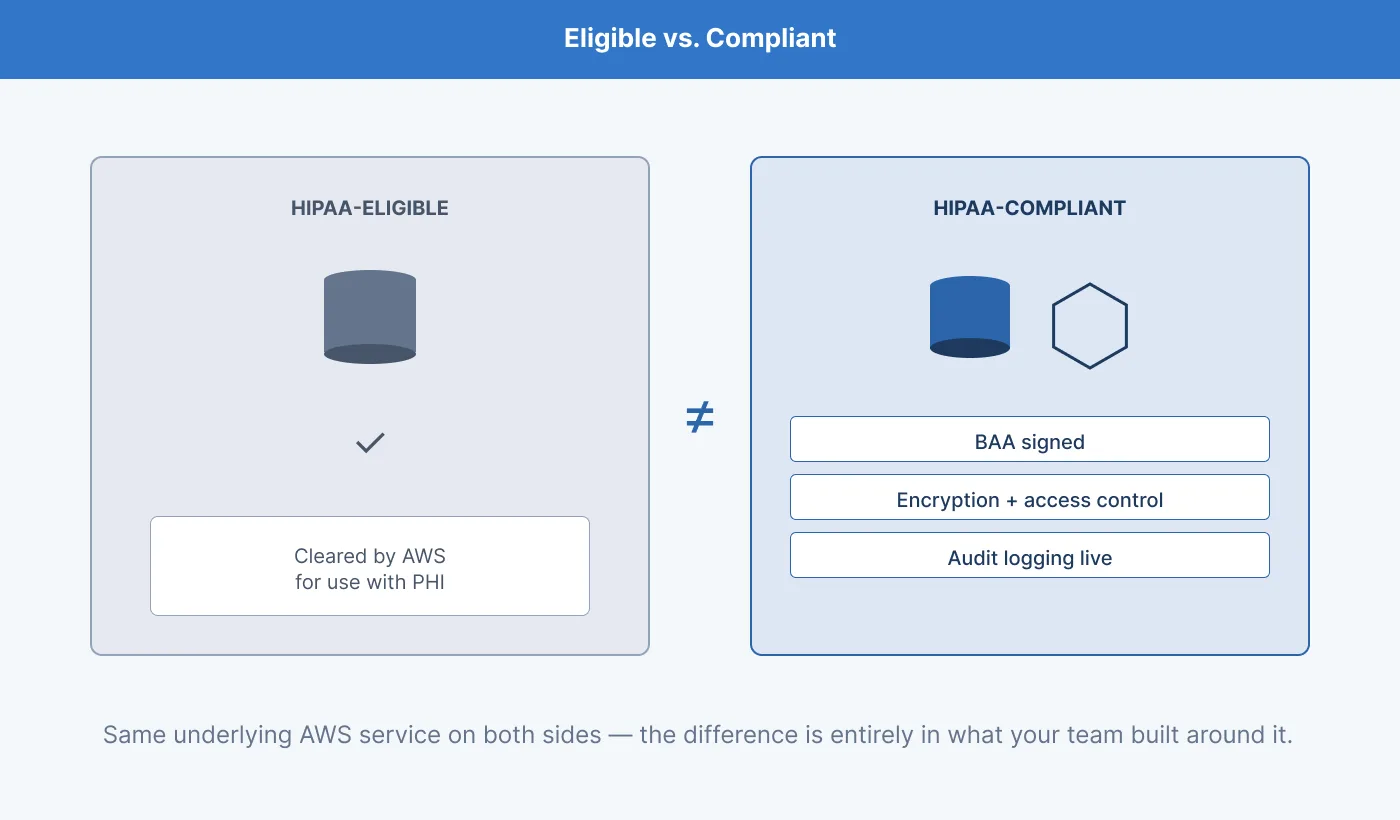
A HIPAA-eligible AWS service just means AWS has cleared it for use with PHI once you've signed a BAA. Amazon S3, Amazon RDS, and Amazon Bedrock all clear that bar. But none of them arrive compliant. System compliance comes down to two things: how you've set up the administrative, physical, and technical safeguards the HIPAA Security Rule requires, and whether every single touchpoint stays inside your BAA boundary.
Eligible and compliant aren't synonyms. A HIPAA-eligible AWS service is not, on its own, a compliant system. Compliance is a property of your architecture, your BAAs, and where PHI is allowed to travel.
A HIPAA-eligible AWS service is not a compliant system. Compliance is a property of your architecture, your BAAs, and where PHI is allowed to travel, not a setting you enable.
So compliance isn't a toggle. It's a property of your architecture, your BAA coverage, and the paths PHI is allowed to move through. Forget one sub-processor, an email API, an analytics SDK, an error-tracking tool, and the whole eligible-services list becomes irrelevant.
MVP vs. Prototype vs. Pilot in a Regulated Context
Most healthcare AI content treats these three terms as interchangeable. That sloppiness costs teams real money.
- A prototype touches only dummy or de-identified data and carries no HIPAA obligation. Its job is validating the AI approach, but not the compliance posture.
- A pilot touches real PHI (Protected Health Information), even if only with a small, controlled group of users. That means the full compliance stack, BAAs, encryption, audit logging- needs to be in place before it's even generally available.
- An MVP goes further still. It's the smallest version of the product that touches real PHI inside a live clinical or operational workflow, built so it can scale without needing a compliance rebuild later.
The AWS Building Blocks: Which Services Are HIPAA-Eligible
AWS maintains an official HIPAA-Eligible Services Reference listing every service that can be used with PHI under a signed BAA. It was last updated in September 2026, and it's the only source you should trust over a vendor blog. Eligibility is the floor. The services below are the ones that actually matter for a healthcare AI MVP, if not the full list of more than 150 services.
|
AWS Service |
HIPAA-Eligible? |
Role in an AI MVP |
|---|---|---|
|
Amazon S3 |
Yes |
PHI object storage, document/image ingestion |
|
Amazon RDS |
Yes |
Structured PHI (patient records, encounters) |
|
Amazon Aurora |
Yes |
Structured PHI at larger scale/availability |
|
AWS KMS |
Yes |
Encryption key management for all PHI at rest |
|
Amazon Bedrock |
Yes |
Foundation-model inference (generation, summarization, extraction) |
|
Amazon SageMaker AI |
Yes |
Custom model training and hosting |
|
Amazon Comprehend Medical |
Yes |
Clinical NLP, with entity extraction from unstructured notes |
|
AWS HealthLake |
Yes |
FHIR R4-native data store for interoperability |
|
AWS CloudTrail, Amazon Macie, AWS Security Hub CSPM |
Yes |
Audit logging, PHI discovery, security posture monitoring |
The core idea to remember is that eligibility is the floor, not the finish line. The harder part is composing these services into a governed system. For how NeenOpal approaches this at the architecture level, see our AWS Generative & Agentic AI Competency practice, recognized at Advanced Tier alongside AWS Well-Architected Partner status.
So what does composing AWS HIPAA-eligible services into a governed system actually look like in practice? It starts here, with the layer holding your patient data itself.
The Compute + Data Layer: S3, RDS/Aurora, KMS, VPC/PrivateLink
Most HIPAA violations do not happen in a random corner of your AWS setup. They happen in the compute and data layer, the part every team configures once during the MVP build and then never really looks at again.
Encrypting PHI at rest with your own KMS keys instead of AWS defaults is the first piece. It puts key rotation and access revocation in your team's hands. The second piece is keeping PHI away from the public internet altogether. A VPC paired with AWS PrivateLink keeps that traffic contained, so requests moving between your storage and Bedrock or SageMaker never touch the open internet.
Retrofitting this layer later gets expensive fast because nobody notices right away. PHI just quietly ends up somewhere it shouldn't have: a log file, a backup, a cache sitting outside your compliance boundary. Handle the KMS keys and PrivateLink setup properly now, at MVP stage, and this part of the build likely will not need revisiting again until well past Series B.
The AI Layer: Bedrock, SageMaker, and Comprehend Medical, and Their Eligibility Caveats
Amazon Bedrock is the fastest path to a working AI feature. It gives you managed access to foundation models, including Anthropic's Claude family, without hosting the infrastructure yourself. It's HIPAA-eligible, but that eligibility is granted at the model-and-region level rather than the entire service. A model covered by a BAA in one region may not be covered in another, and new models sometimes get added to the eligible list only after their general release.
SageMaker earns its place when a foundation model can't solve the problem, typically a custom model fine-tuned on proprietary clinical data. Comprehend Medical sits between the two, extracting structured entities such as medications, diagnoses, and dosages from unstructured clinical text as a pre-processing step. All three demand the same discipline to check the AWS HIPAA Eligible Services Reference for your exact service and region before you build on it.
The 6-Week MVP Build Plan (What We'd Actually Ship First)
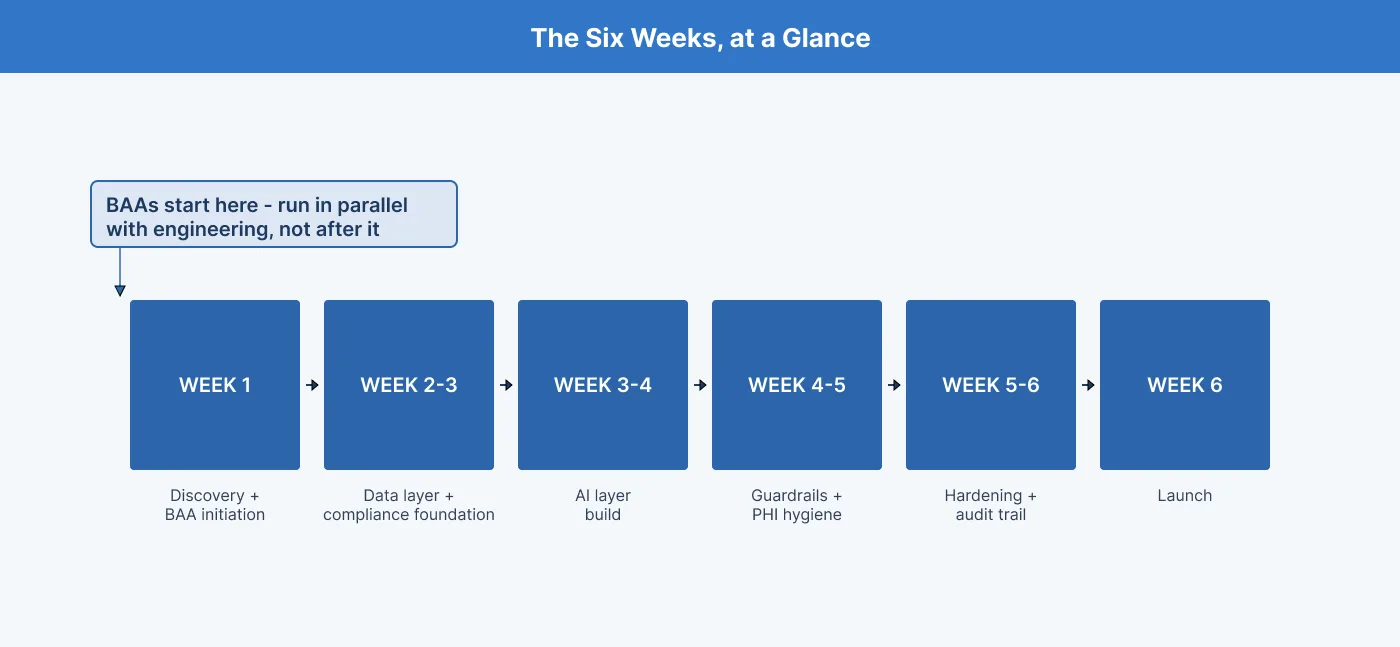
A fixed-scope healthcare AI MVP ships on AWS in about six weeks; every net-new PHI data source or integration adds one to two. The model is rarely the long pole; data ingestion and BAAs are.
Six weeks is realistic to set up a healthcare AI MVP on AWS if you fix the scope before week one and reuse pre-integrated AWS building blocks instead of custom infrastructure. However, it extends if compliance work starts after the AI feature already "works" in a demo. This is because that incorrect ordering is precisely how MVPs turn into rebuilds.
We shipped Mokkup.ai, our own generative AI product built on Amazon Bedrock, from pilot to production in roughly two weeks. That's proof the AWS-native path is fast when scope stays disciplined, even before layering in HIPAA-specific controls.
Week-by-Week Phase Table
|
Week |
Phase |
What Actually Happens |
|---|---|---|
|
1 |
Discovery + BAA initiation |
Scope lock, PHI data-flow mapping; AWS BAA and sub-processor BAAs go out in parallel. Avoid waiting on this |
|
2–3 |
Data layer + compliance foundation |
S3/RDS provisioning, KMS key policies, VPC/PrivateLink network boundary, CloudTrail logging turned on |
|
3–4 |
AI layer build |
Bedrock (or SageMaker) integration, prompt design, Comprehend Medical pre-processing if needed |
|
4–5 |
Guardrails + PHI hygiene |
Bedrock Guardrails configuration, prompt redaction, log-scrubbing for PHI, output filtering |
|
5–6 |
Hardening + audit trail |
Access control review, audit-log completeness check (including inference calls), penetration/security review |
|
6 |
Launch |
Production cutover, monitoring live, incident-response runbook confirmed |
Note what's absent from week one: model selection. That's deliberate. The AI layer is the fastest part of this build, and picking a model first is how teams end up re-architecting data plumbing around that choice instead of the other way around. It's the same discipline behind our MVP accelerator approach, which can get teams from zero to live in under a month when scope stays fixed.
Why BAAs and Data Ingestion Are the Real Long Poles
BAA execution, with AWS and every third-party sub-processor touching PHI, runs on legal timelines your engineering team doesn't control. That's the reality of shipping HIPAA-compliant AI on AWS, which is exactly why it needs to start on day one.
Data ingestion is the second long pole. Connecting to an existing EHR, claims system, or legacy database almost always surfaces data-quality and format issues that no amount of AI-layer sophistication can shortcut. Every net-new PHI source, whether that's a second EHR, a lab-results feed, or a third-party eligibility check, adds one to two weeks to the timeline. That's the honest answer to "how much does this cost" before a single line of code changes.
Minimum Viable Compliance: What to Build Now vs. Defer
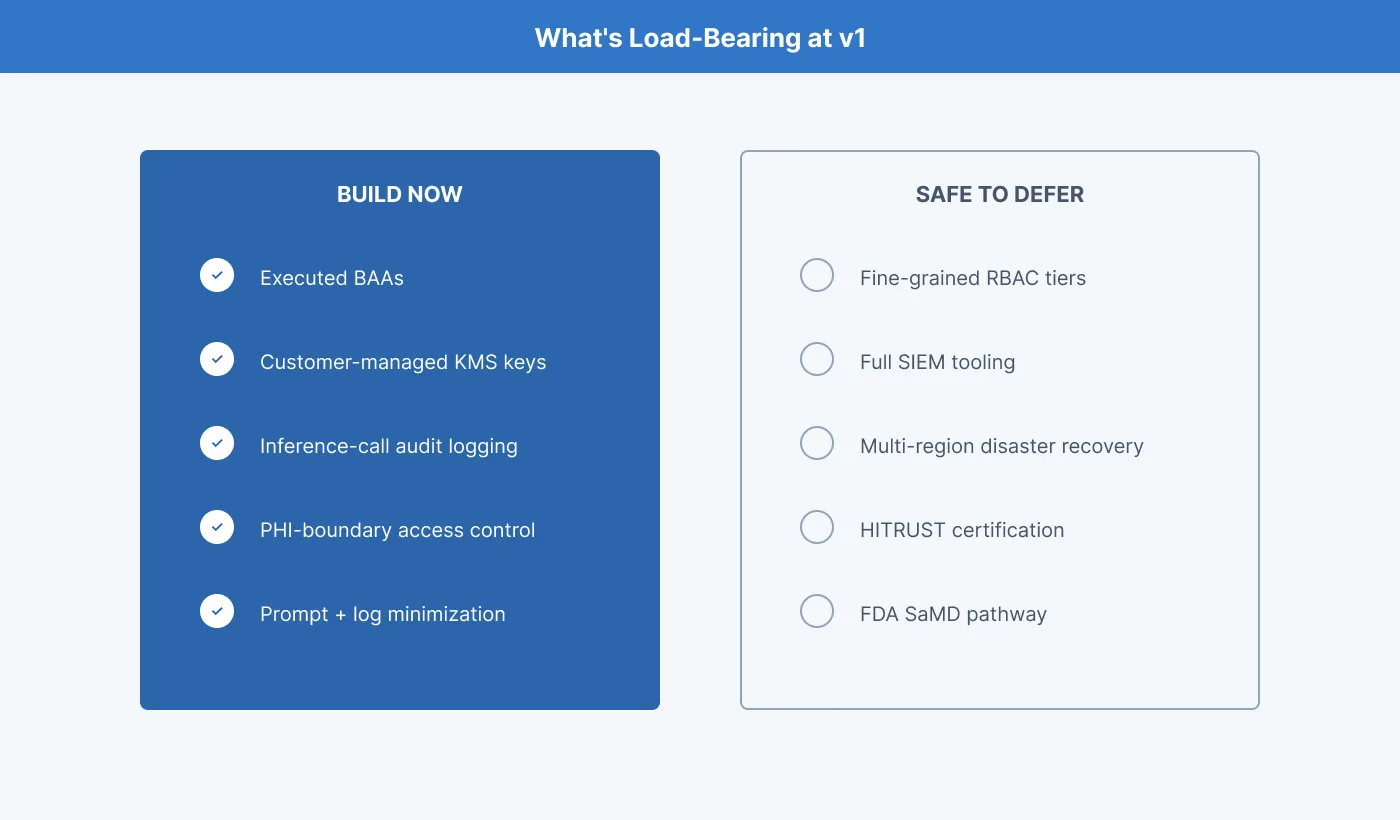
Some compliance controls are load-bearing at v1. Others are safe to defer until a specific, identifiable trigger arrives. Guessing wrong in either direction gets expensive. Over-building burns runway you needed for the actual product, and under-building forces a rebuild the moment an auditor, a security-conscious enterprise customer, or a second PHI data source shows up.
Deferring the wrong compliance control is the most expensive mistake in a healthcare MVP: encryption, BAAs, and audit logging are load-bearing at v1; fine-grained RBAC and full SIEM can wait.
The decision rule we use to define minimum viable compliance in delivery is simple. Build now if the control touches PHI storage, transport, or access, or if it would be hard to add later without downtime or moving live data around. Defer if the control is something you can safely add later without touching data that's already live. The HIPAA Privacy Rule's minimum necessary standard and the 60-day breach notification obligation both fall on the build-now side, since both depend on having access and audit controls already in place.
The Build-Now List (and Why Each Is Hard to Retrofit)
- Executed BAAs cover AWS and every sub-processor that can see PHI, including logging, email, and analytics vendors. Fixing this after PHI has already passed through an uncovered vendor can turn into a breach notification.
- Customer-managed KMS keys replace AWS-managed defaults. Migrating encryption schemes on live PHI data means a re-encryption pass across every store, which is operationally risky and slow.
- Inference-call audit logging covers more than database reads and writes. Most teams log application-layer access and miss that the Bedrock or SageMaker call itself, where PHI actually enters a model, needs its own audit trail.
- PHI-boundary access control, meaning IAM policies and VPC isolation, matters because retrofitting network segmentation on a live system means downtime and a re-architecture, not a patch.
- Prompt and log minimization means deciding upfront what data reaches a model call and what gets redacted first. This is a design decision baked into your application logic, not a setting you flip later.
The Safe-to-Defer List (and the Trigger That Ends the Deferral)
- Fine-grained RBAC tiers beyond basic role separation can wait until you have distinct user roles with genuinely different PHI access needs, typically triggered by your second enterprise customer.
- Full SIEM tooling beyond CloudTrail and Security Hub can wait until log volume or team size makes manual review genuinely impractical.
- Multi-region disaster recovery can wait until an enterprise customer's contract or a specific uptime SLA requires it. Single-region with solid backups is defensible at MVP stage.
- HITRUST certification can wait until a health-system customer's procurement process specifically requires it. It's a significant time and cost investment that most MVP-stage buyers don't demand.
- FDA SaMD pathway needs attention only once your feature's intended use crosses into diagnostic or treatment-decision territory. Monitor this threshold closely, because addressing it retroactively is far more expensive than designing around it from the start.
The Healthcare AI Reference Architecture (Grounded in a Real Build)
Every "reference architecture" in the healthcare-AI-on-AWS content out there is hypothetical, a diagram nobody actually deployed. Here is the pattern we deploy, grounded in two real products: Mokkup.ai, our own Bedrock-native SaaS, and a live healthcare risk-scoring tool. Not a diagram. A shipped system.
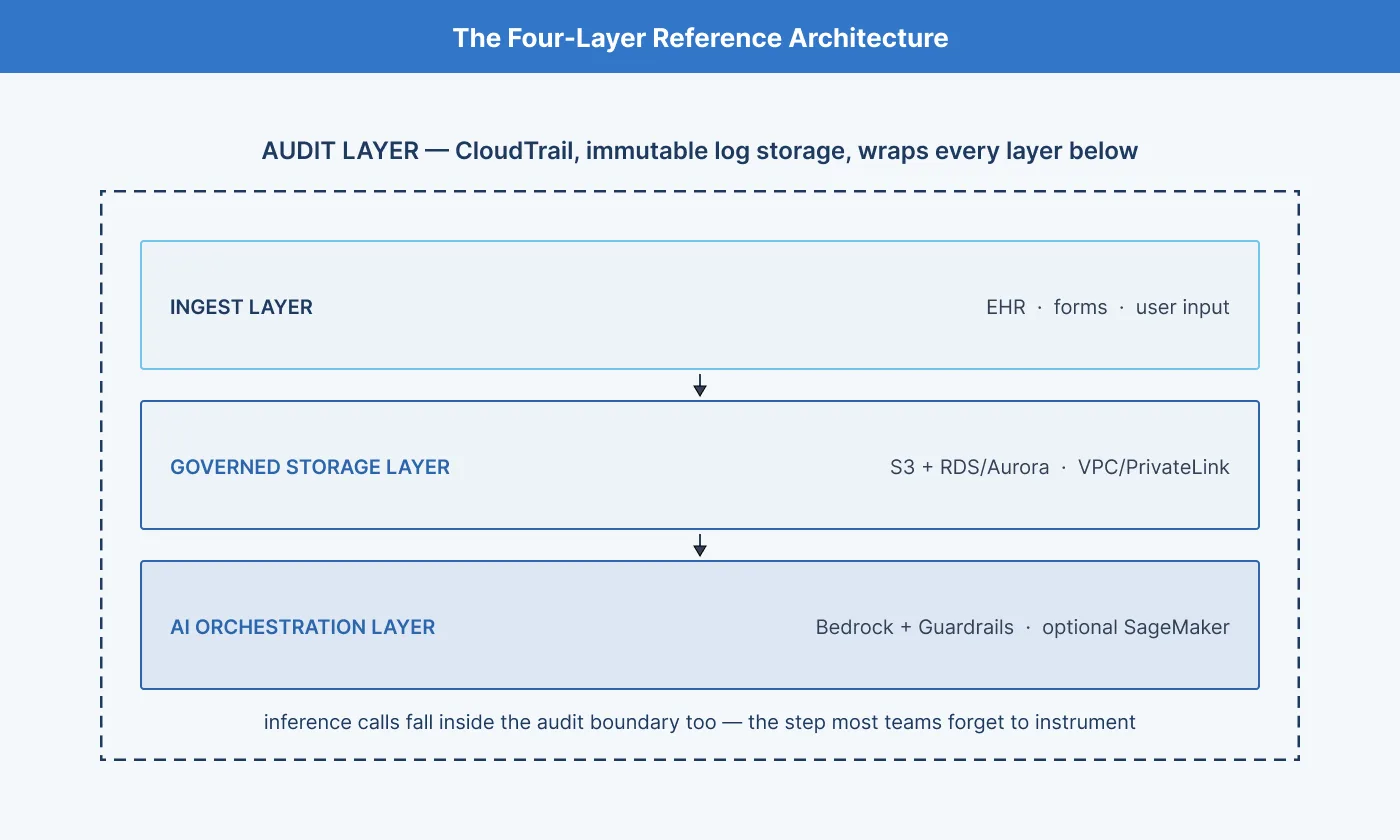
The pattern has four layers:
- The ingest layer pulls data from EHRs, forms, or user input, landing first in a governed PHI store rather than directly into application logic.
- The governed storage layer, meaning S3 with Object Lock and KMS encryption plus RDS/Aurora for structured records, holds PHI behind VPC/PrivateLink isolation, with every access path logged.
- AI orchestration layer, meaning Bedrock with Guardrails for PHI redaction and optionally SageMaker for custom models, sits behind storage rather than in front of it, so inference is never the entry point for unvetted data.
- Audit layer, meaning CloudTrail with immutable log storage, wraps every other layer, including the inference calls most teams forget to instrument.
It's the same shape behind our real-time risk-stratification tool for addiction-treatment providers, which scores patient risk profiles in under 30 seconds on EC2, RDS, S3, and EventBridge. That's the closest real analog to the build most readers here are scoping.
The Data Backbone: A Governed PHI Store on AWS
The data backbone determines whether v2 is an extension or a rewrite, because migrating a live PHI store is one of the few genuinely irreversible mistakes in this stack. Our data engineering practice, including a healthcare data platform we built for a Canadian provider network that consolidated 10+ fragmented sources into a governed warehouse, treats schema design and access boundaries as the first architecture decision.
Get the data model right, and the AI layer stays interchangeable. Get it wrong, and every downstream decision inherits the mistake.
The AI Layer: Bedrock + Guardrails, and When SageMaker Earns Its Place
Bedrock Guardrails is the control most teams under-invest in, because it doesn't show up in a demo. It can catch PHI trying to leave through a model's output, not just what goes in. Set up Guardrails, with custom rules layered on top of its built-in filters, to catch PHI in both prompts and responses, and treat every model response as a possible leak until you've checked it. Our generative and agentic AI work applies this same pattern: Bedrock by default and SageMaker reserved for genuinely custom needs, across the regulated builds we run.
SageMaker earns its place only when a foundation model clearly can't do the job because it brings real MLOps overhead (training pipelines, model monitoring, drift detection) that a six-week MVP timeline usually can't absorb.
For most clinical Q&A or documentation use cases, a retrieval-augmented generation (RAG) pattern over Bedrock, with a human review in the loop, may get you further, faster, than a custom-trained model.
Hidden Limitations the Vendor Docs Won't Tell You
The dangerous gaps in a healthcare AI build rarely show up in the architecture diagram. They live in the seams between systems that no vendor documentation walks you through, because no single vendor owns the whole seam. The numbers reflect the scale of harm it does. IBM's 2026 Cost of a Data Breach Report puts the average healthcare breach at $6.64 million, the highest of any industry for the 13th year running.
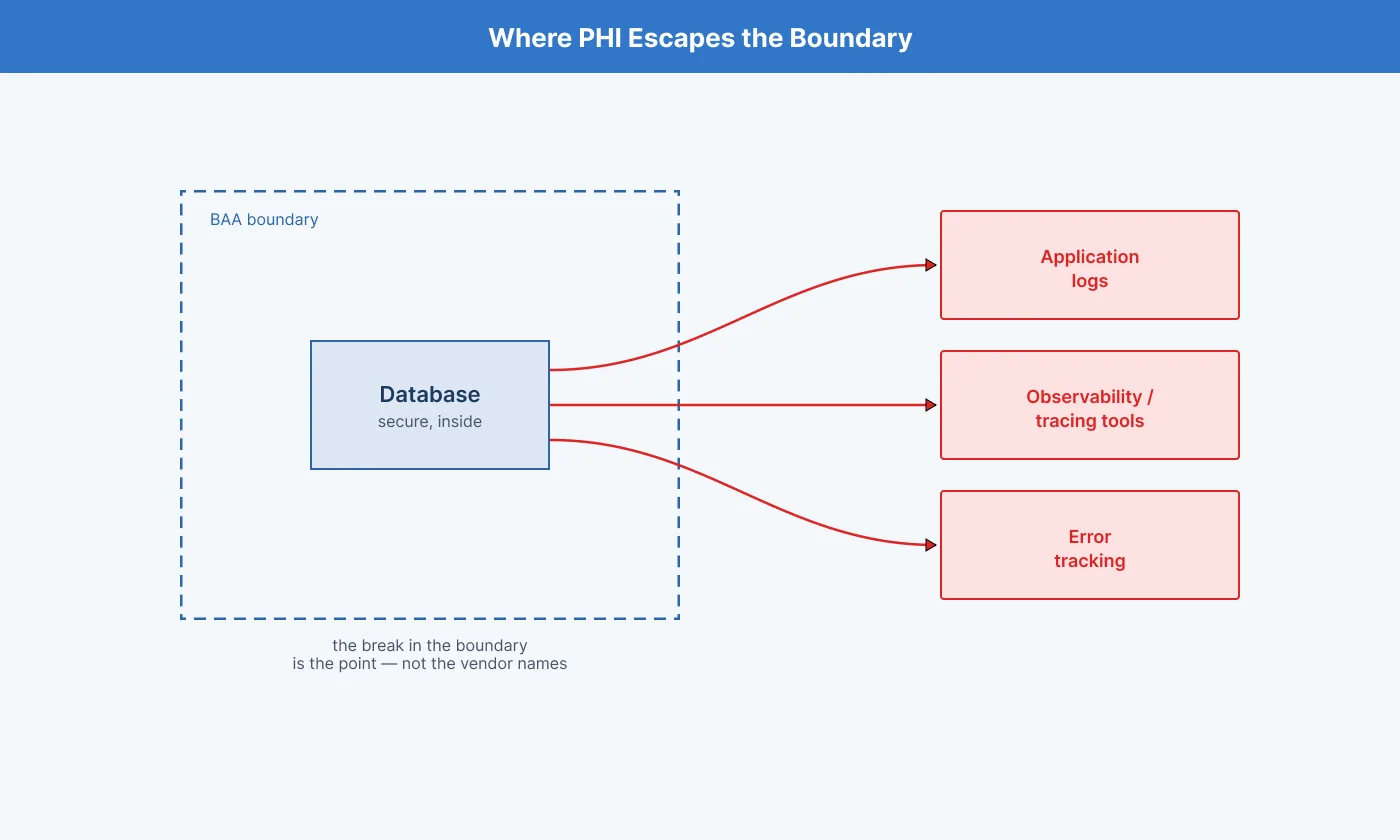
PHI most often leaks not through the database but through prompts, logs, and LLM traces. The exact paths teams forget to pull inside the BAA boundary.
Where PHI Silently Escapes the Compliance Boundary
Teams secure the database meticulously but still leak PHI through three paths that they forget to involve into the BAA boundary.
Application logs save the entire request, including the prompt sent to a model. Observability and tracing tools record what goes into and comes out of the LLM for debugging. Error-tracking tools capture the app's full state, prompt included, the moment something breaks.
Each of these is often a separate vendor and needs its own BAA for PHI to reach, which most teams don't notice until a security review catches it.
The fix isn't complicated in concept. Remove PHI before it enters a log line, and scope every observability vendor into your BAA inventory before go-live, not after a customer's security team asks for it. It's easy to skip under a six-week deadline, which is exactly why we included it in the build-now list
The BAA and Model-Eligibility Traps in Generative AI
The most common mid-build discovery in our delivery experience is a non-BAA sub-processor found after the architecture is already committed, whether that's an analytics SDK, a customer-support chat widget, or a third-party API that turns out to touch PHI in a way nobody flagged during vendor selection. The second is an AWS Bedrock HIPAA mismatch between model and region, where a team builds against a specific foundation model in development, then discovers at launch that the model isn't available in their production region, or wasn't enabled for their account until after they'd already built a dependency on it.
Both failure modes are avoidable with the same discipline in any healthcare AI MVP on AWS. Every vendor and every model-region pairing needs a BAA-coverage check before you build on it. Waiting until a customer or auditor asks is how these gaps turn into fire drills. It's also exactly why ISO 42001-grade AI governance exists: catching this kind of gap systematically beats hoping one engineer remembers to check.
Where the MVP Approach Breaks at Scale (The Enterprise Wall)
The MVP architecture described above is correct until your second customer, your first audit, or your first model-drift incident. Naming the exact break point matters more than most competitor content admits, because most healthcare AI MVPs don't fail on model quality at all.
Most healthcare AI MVPs don't break on model quality. They break on multi-tenant PHI isolation the day the second customer signs.
A single-tenant MVP can get away with looser data isolation than a multi-tenant SaaS product needs, because there's only one customer's PHI in the system. The day a second customer signs, every shared resource, the database, the S3 buckets, the Bedrock invocation logs, needs a tenant boundary that either existed from day one or now requires a migration on live PHI data. In our delivery experience, this is the single most common wall healthcare AI MVPs hit first, ahead of model performance, UI polish, and almost everything else in the backlog.
Three more walls follow close behind:
Audit-evidence generation is one. A first real compliance audit or enterprise security review asks for access logs, BAA inventories, and encryption attestations an MVP team assumed existed but never assembled into auditable form.
Model drift monitoring is another. MVP monitoring usually checks whether the system still works, not whether its behavior has changed, and nobody plans for six years of unchangeable log storage until the bill arrives.
The FDA SaMD threshold is the third. If the feature's use shifts from informational to diagnostic or treatment-affecting, it becomes a regulated medical device overnight, changing the entire compliance posture.
We've shipped AI products to production on AWS in roughly three weeks, and we've seen exactly where healthcare MVPs hit the multi-tenant and audit walls. If you're scoping a build and want a second set of eyes on the decisions that are hard to reverse, our MVP accelerator team is happy to talk through the architecture with you.
Why Architecture Decisions Decide the Real Cost
The cost of a healthcare AI MVP is set less by build hours than by two or three architecture decisions made in week one that determine whether v2 is an extension of the MVP or a rewrite of it.
The cost of a healthcare AI MVP is set less by build hours than by two or three irreversible architecture decisions, which are the data model, the PHI boundary, and tenancy.
The data model is the first irreversible decision. Get the schema and the FHIR/HL7 mapping wrong, and every feature built on top inherits a migration debt that compounds. The PHI boundary is the second: which services, vendors, and logs sit inside your BAA coverage, and expanding it later means auditing everything you already shipped. Tenancy is the third, meaning single-tenant versus multi-tenant data isolation, and most teams get it wrong often, because it doesn't matter until it does.
The rule that follows is simple. Spend architecture time on the irreversible decisions, and move fast and cheap on everything reversible, including UI choices, which specific foundation model you start with, or whether you use Bedrock's built-in agents versus a custom orchestration layer, since all of these can change later without touching PHI.
This same logic, protecting the decisions that are expensive to reverse while moving quickly everywhere else, is what we apply in cost-efficient agentic AI architecture work, and it's the AWS Generative & Agentic AI Competency lens (Advanced Tier, Well-Architected) we bring to every healthcare build.
Thinking about a healthcare AI MVP on AWS?
Book a 30-minute architecture review with a NeenOpal AWS-certified architect. We'll pressure-test your scope, flag the irreversible decisions, and map the fastest compliant path to launch, no obligation.
Frequently Asked Questions
1. Is AWS HIPAA compliant for AI?
No cloud platform can be "HIPAA compliant," AWS included, since that's not how the law works. What AWS offers is HIPAA-eligible services you can use compliantly once you've signed a BAA and built the right controls around them. Eligibility is about the infrastructure. Compliance is about what your team actually built on top of it.
2. Is Amazon Bedrock HIPAA eligible?
Yes. Amazon Bedrock carries HIPAA eligibility under a signed BAA, confirmed on AWS's official HIPAA Eligible Services Reference. Eligibility can shift by specific foundation model and AWS region, so check both before you commit to a model in your architecture.
3. How much does a healthcare AI MVP cost?
Honestly, there's no single number that means much here. Cost tracks with how many PHI data sources you're connecting, how messy the EHR or claims integration turns out to be, and how much of the compliance tail, things like BAAs, audit tooling, and guardrails, gets scoped in up front instead of bolted on later. A disciplined, single-data-source MVP comes in cheapest, and every additional integration adds real cost from there.
4. How long does it take to build a HIPAA-compliant AI app?
Realistically, about six weeks for a fixed-scope MVP, with each new PHI data source or integration tacking on another one to two weeks. BAA execution should run in parallel starting day one. Waiting until week four is how timelines slip.
5. Do I need a BAA with AWS?
Yes, and that's just the start. Storing, processing, or transmitting PHI on AWS requires an executed AWS BAA, plus separate BAAs with every other sub-processor touching that PHI- think analytics, logging, email, and support tools. Skip even one, and the whole chain breaks no matter how well AWS itself is configured.
6. Which AWS services are HIPAA eligible?
For a healthcare AI MVP, the core set usually includes Amazon Bedrock, Amazon SageMaker AI, Amazon Comprehend Medical, AWS HealthLake, Amazon S3, Amazon RDS/Aurora, and AWS KMS. They're all on AWS's HIPAA Eligible Services Reference, though several come with model, engine, or feature-level exclusions worth double-checking before you build.
7. Can I put PHI in an LLM prompt?
Only inside your BAA boundary, and only after minimizing what you send, meaning the model gets exactly what it needs from the full record and nothing more. Honestly, the bigger risk isn't even the prompt. It's PHI showing up unredacted in application logs, observability traces, or error-tracking snapshots downstream of that model call.
8. When does a healthcare AI feature become an FDA-regulated device?
Once its intended use crosses into FDA Software-as-a-Medical-Device (SaMD) territory, basically when the software's output starts directly informing a diagnosis or treatment decision instead of just organizing or presenting information. It's worth designing around this early, since reclassifying after launch costs a lot more than scoping the feature's intended use carefully from day one.