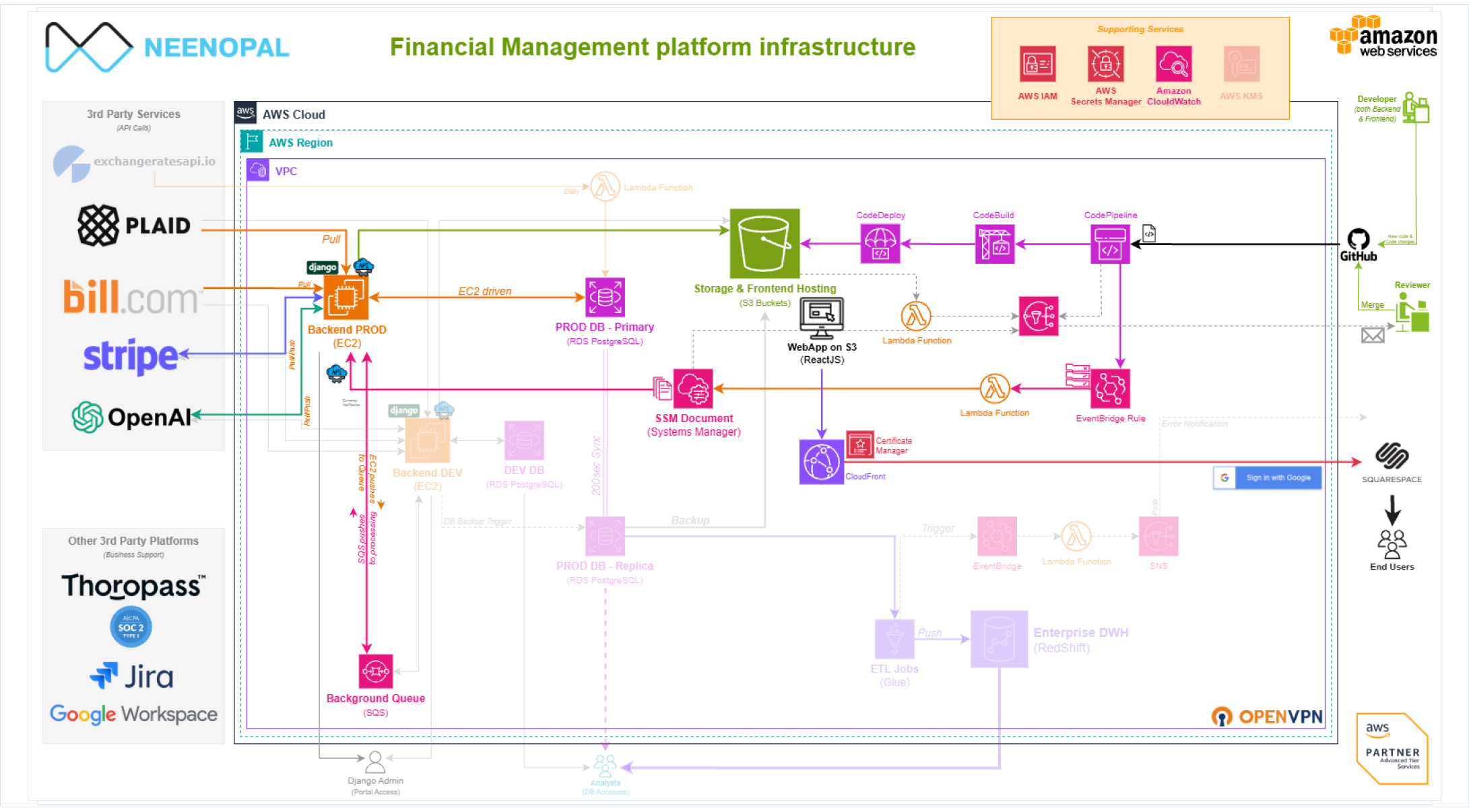
Financial data from multiple APIs flows into a serverless AWS pipeline where lightweight OpenAI models classify transactions in real time based on user-defined categories.
 ×
×

Traditional financial management tools struggle to personalize categorization at scale, often locking users into rigid category structures. NeenOpal, leveraging AWS and OpenAI, built a FinTech SaaS platform that integrates seamlessly with services like Plaid, Stripe, and Bill.com to automate income and expense categorization. By using lightweight LLMs, we enabled user-defined financial categories with real-time AI-powered classification, creating a personalized, scalable, and cost-efficient solution.
98%
Accuracy in Transaction Categorization
80%
Faster Deployment of Custom Categories
10+
Data Integrations with Leading FinTech APIs
50%
Reduction in Manual Categorization Effort
Despite leveraging multiple FinTech tools, businesses faced persistent obstacles in achieving accurate and personalized financial categorization. Traditional approaches lacked flexibility, were costly to maintain, and failed to unify fragmented financial data.

Predefined static categories failed to capture diverse user needs across geographies.

Users couldn’t define their own categories, limiting flexibility in financial planning.

Changing categories required ML model retraining, making the process costly and time-consuming.

Financial data came from multiple APIs, Plaid, Stripe, Bill.com, etc., in inconsistent formats.

Large language models were overkill, while traditional models lacked flexibility.
NeenOpal built an AI-powered financial SaaS platform on AWS, integrating lightweight OpenAI models to classify transactions dynamically. Users could define their own expense categories, and the system would auto-classify based on natural language descriptions from transaction metadata.
01.
The solution integrates Plaid, Bill.com, Stripe, and more, normalizing data across different platforms.
02.
Instead of heavy ML pipelines, OpenAI’s low-cost models classify transactions contextually, cutting infrastructure and retraining costs.
03.
Built using AWS Lambda, S3, API Gateway, and RDS, the solution is serverless and scales with usage, optimizing cost and performance.
04.
Each user submits their own categories, e.g., “Dining Out,” “Groceries,” “Treats”, which are used for real-time classification using GPT-based APIs.
Build Smarter FinTech Products with AI-Powered Financial Intelligence
Talk to Our Experts


Users enjoy complete control of exactly how their transactions are organized.

No need to train new ML models, OpenAI APIs handle classification on the fly.

Aggregated data across Plaid, Stripe, Bill.com, etc., in one unified interface.

Lightweight models provide >95% accurate classification at a fraction of the cost.

Serverless, modular architecture ensures smooth scalability and easy iteration.
NeenOpal’s AI-enhanced FinTech SaaS, powered by AWS and OpenAI, delivers a highly customizable transaction classification engine. It transforms traditional financial tracking by empowering users to define what matters most to them. The result? Faster deployments, smarter insights, and a truly personalized financial experience, delivered at scale.
Frequently Asked Questions on Personalized Financial Categorization with AI-Powered SaaS on AWS
AI-powered categorization uses Machine Learning (ML) models to analyze transaction metadata (purpose, merchant name, and patterns) that manual rules often miss. By leveraging AWS-native tools, the system can process millions of transactions in real-time with over 95% accuracy, significantly reducing the "noise" and errors found in human-led or simple regex-based categorization.
Yes. The solution utilizes a "Security by Design" approach on AWS, incorporating end-to-end encryption (AES-256), fine-grained access control via AWS IAM, and secure authentication through Amazon Cognito. The architecture is built to align with SOC 2 and PCI DSS standards, ensuring sensitive financial data is isolated and protected at rest and in transit.
Absolutely. The platform is designed to unify fragmented data by integrating with 20+ financial APIs (like Plaid or Yodlee). NeenOpal’s architecture creates a "standardization layer" that normalizes inconsistent data formats from banks, investment portfolios, and crypto wallets into a single, clean schema for the AI to process
By utilizing AWS Lambda and Aurora Serverless, the platform follows a pay-as-you-go model, eliminating the cost of idle servers. This allows the system to scale instantly during high-traffic periods (like end-of-month reporting) while maintaining sub-2-second API response times (P95), ensuring both cost-efficiency and high performance.
Beyond simple tagging, personalization allows the AI to learn individual household or business behaviors. It enables hyper-personalized insights, such as detecting duplicate charges, predicting future cash flow based on historical trends, and providing collaborative budgeting tools for multi-user accounts (e.g., parents and children), which drives higher user engagement and retention.
Contact Us
Lets discuss how we can transform your business with AI. Talk to our AI expert team. Lets do AI journey together.