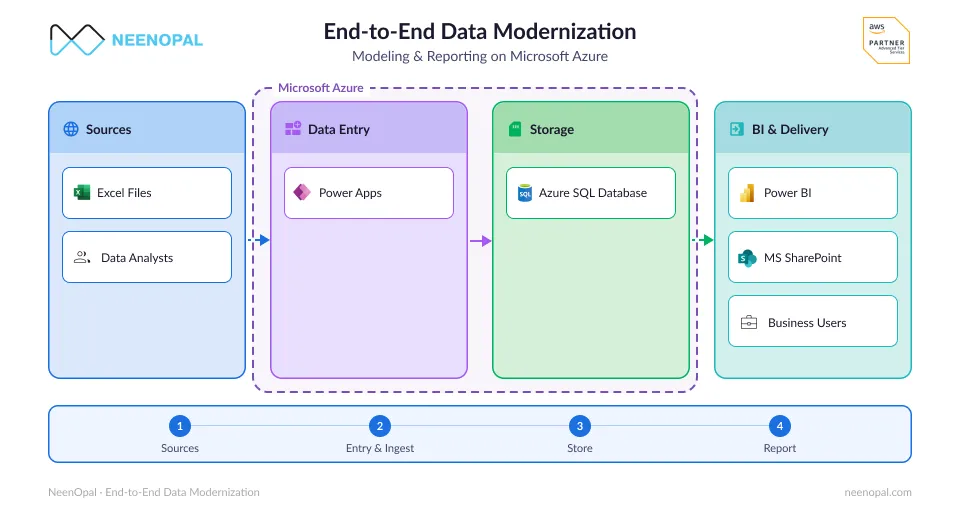
A centralized Azure setup that enforces data validation, automates workflows, and ensures consistent, reliable data across systems.
 ×
×

The client, a leading healthcare organization, initially used Excel to manage critical data. They approached NeenOpal to build a more reliable backend system using Azure SQL that would improve data consistency, reduce manual work, and support better data control. The project focused on setting up strong validation rules, automated processes, and referential integrity features like cascading updates to create a scalable, accurate, and future-ready data environment.
As data needs grew more complex, the client’s Excel-based setup began to fall short in maintaining consistency, accuracy, and efficiency. Key challenges emerged across data validation, duplication, and maintenance processes, making it difficult to scale or ensure data reliability.

The client's existing system allowed users to enter any value freely in Excel, leading to inconsistent naming, unauthorized categories, spelling errors, and non-standard formats. Without centralized control or enforced validation rules, it became difficult to trust the data for reporting or decision-making. These inconsistencies compounded over time, leading to major clean-up efforts and data discrepancies across departments.

Duplicate entries frequently occurred due to the lack of a centralized system that could flag or block such issues. This was particularly problematic in key dimension fields where uniqueness was critical. The presence of duplicate values not only caused confusion in reporting but also affected business rules and downstream applications that relied on those fields for lookups or aggregation.

Validation lists (like permissible categories or types) were scattered across different Excel sheets, with no synchronization or version control. Any changes to these lists had to be manually replicated, and errors or omissions often went unnoticed. This fragmented approach to managing reference data made it difficult to enforce business rules consistently and added friction to the data entry process.

Certain fields were used across multiple datasets and needed to be manually updated in each of them whenever there was a change. This led to redundant work, higher risk of mismatches, and delayed updates. Inconsistent updates in related tables also threatened referential integrity and sometimes required full audits to correct.

Several fields in the dataset needed to be derived from related tables based on pre-defined business logic. Since Excel lacked automated mechanisms for these dependencies, users had to perform repetitive lookups and transformations manually. This was not only time-consuming but also error-prone, resulting in delays and inconsistent application of business logic across teams
To modernize the client's data infrastructure, Neenopal designed and implemented a secure, scalable backend powered by Azure SQL. The solution focused on enforcing data governance, automating validation processes, and ensuring seamless data consistency across all systems.
01.
To maintain strict data integrity, the system leveraged multiple SQL constraints within Azure SQL Database. Foreign Key constraints ensured values matched corresponding master tables, eliminating invalid entries and enforcing referential integrity. Unique constraints prevented duplication in key fields, guaranteeing distinct entity identification. Additionally, Check constraints restricted inputs to predefined options (e.g., “Yes,” “No,” “Unknown”), reducing inconsistencies in categorical data. Together, these constraints automated validation at the database level, significantly improving accuracy and data quality without manual intervention.
02.
Previously, validation lists were scattered across multiple Excel sheets and maintained manually. We consolidated these into dedicated reference tables within Azure SQL, creating a single source of truth for all validation rules. By enforcing foreign key relationships, any updates to validation tables dynamically applied across connected datasets, reducing errors and eliminating repetitive updates. This approach simplified maintenance by enabling controlled database operations for adding new values without complex fixes or code changes. Additionally, it improved data governance with better auditability and traceability, ensuring compliance and streamlined operations.
03.
To keep related data consistent, we implemented cascading rules in Azure SQL. With “On Update Cascade”, any change to a key in a parent table automatically updates all matching foreign keys in child tables—no manual cleanup, no mismatched IDs. With “On Delete No Action”, critical records can’t be removed while still referenced elsewhere, preventing orphaned rows and unintended data loss. Together, these constraints streamline data management, enforce disciplined delete workflows, and protect the system from referential breaks and corruption. Let me know if you want a version with a quick example (e.g., customers → orders).
04.
To manage fields dependent on other datasets or complex calculations, we implemented stored procedures that handled data extraction, transformations, and population of derived fields. These procedures encapsulated all business logic, ensuring consistency and accuracy. Using Azure Data Factory pipelines, we scheduled these jobs to run multiple times daily, delivering near real-time updates without manual intervention. This automation minimized repetitive effort, improved data freshness and accuracy, and allowed users to focus on strategic tasks instead of routine updates.
Ready to modernize your data infrastructure with secure, automated, and scalable architecture? Book a Demo
Book a Call


Enforced validation rules, unique constraints, and cascading updates ensure consistent, clean data, eliminating errors and reducing costly rework.

Scheduled stored procedures and automated data pipelines via Azure Data Factory significantly reduced manual intervention, speeding up data processing and enabling near real-time updates.

Centralized validation lists and referential integrity controls simplify maintenance, improve data governance, and ensure compliance with organizational standards.

Built on Azure’s cloud-native services, the solution scales effortlessly to accommodate growing data volumes and evolving business needs without compromising performance or security.
NeenOpal delivered more than just a data management system, we enabled a foundation of data integrity and automation. Our client now benefits from accurate, validated data with streamlined workflows that reduce errors and improve efficiency. Built on Microsoft Azure’s powerful and scalable platform, the solution is designed to grow, adapt, and support the client’s evolving business needs with confidence and agility.
Everything you need to know about strengthening data integrity, automation, and scalable Azure architecture.
By implementing foreign keys, unique constraints, check constraints, and cascading updates to enforce strict validation at the database level.
Through automated stored procedures and Azure Data Factory pipelines that handled validations, transformations, and derived field updates.
By centralizing validation lists, enforcing referential integrity, and building on a secure, cloud-native Azure architecture.



Contact Us
Lets discuss how we can transform your business with AI. Talk to our AI expert team. Lets do AI journey together.