
Overview
Our client, a leading U.S. energy company, is building a centralized Snowflake Data Warehouse (DWH) to unify data from Salesforce, Meta, Bing, Google, and NetSuite. This improves data analysis, reduces inconsistencies, and enhances accessibility. NeenOpal’s solution ensures seamless data management with robust governance and security measures.
Customer Challenges
As the client expanded its operations, inefficient data management, security risks, and scalability limitations hindered their ability to make informed decisions. The lack of a unified system led to fragmented insights, manual inefficiencies, and governance issues.

Data Quality Issues
Data quality varied significantly due to the different formats and standards used across multiple sources. For instance, exports from various platforms to CSV files frequently featured inconsistent date formats and time zones. This lack of uniformity resulted in inaccuracies during data aggregation, leading to a misleading representation of information.

Performance and Scalability
As the business expanded, particularly with a significant increase in sales during Q4 of 2022 and Q1 of 2023, the volume of data generated and the demand for analysis grew exponentially. Managing and analyzing this surge in data through flat files became increasingly untenable, creating substantial challenges related to scalability and performance.

Historical Data Analysis
The business struggled to capture and analyze historical data effectively, which is crucial for identifying trends and informing strategic decisions. Platforms like Salesforce provided reports that only reflected the data as of the current viewing date, making it difficult to track historical trends and patterns.

Data Logs
The absence of data log capture compounded troubleshooting and data recovery challenges. Important changes in data fields, like dates adjusting to installation milestones, were not logged. This oversight made tracking changes difficult, and independent flat files were ill-suited for effective log management.

Data Security
Insufficient controls over the visibility and protection of sensitive information posed significant risks. The reliance on flat file reporting meant there was no formal mechanism for data security and governance. Additionally, the absence of data masking for customer information further exposed it to potential security threats.

Fragmented Data Landscape
The business faced significant challenges due to fragmented data spread across multiple platforms, making data correlation difficult. Marketing expenditures on Meta, Google, and Bing were analyzed through separate Excel exports, which complicated the evaluation process. Additionally, aligning NetSuite financial reports with Salesforce sales data led to inconsistencies, ultimately undermining trust in the reporting process.
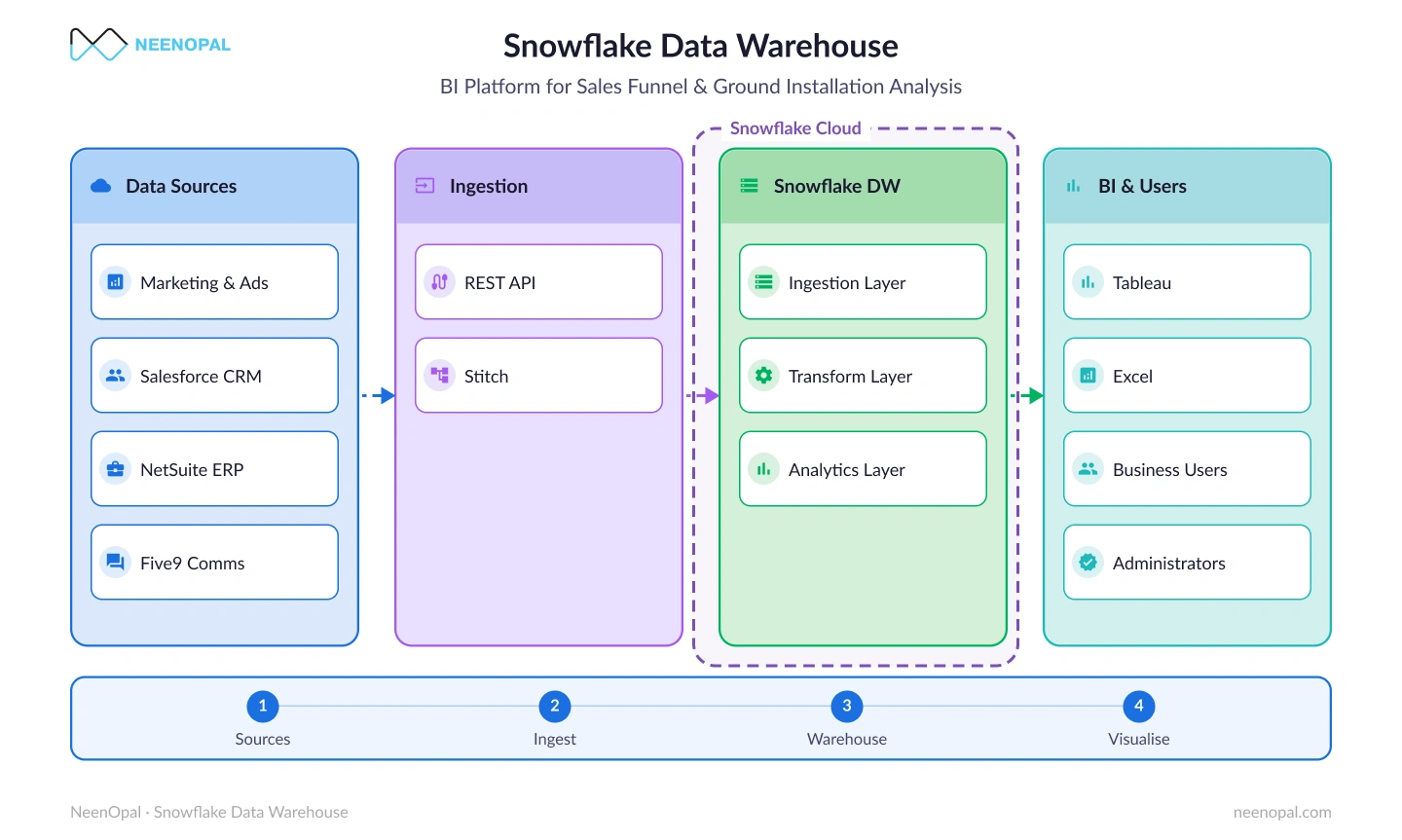
Unified Snowflake Data Warehouse Architecture
A centralized architecture integrating Salesforce, Meta, Google, Bing, and NetSuite into Snowflake, enabling standardized data processing, scalable analytics, secure governance, and reliable historical insights for improved decision-making.
Solutions
To address these challenges, we implemented a Data Warehouse solution using Snowflake, which provided a centralized and secure environment for the client's data. This allowed us to integrate various data sources effectively and create a more streamlined approach to data management.
01.
Centralized Data Architecture
We established a robust data integration strategy using Python automation scripts and Stitch connections to extract data from all sources. This ensured zero data loss and included a streamlined workflow from data acquisition to staging, transformation, and production. This approach consolidated data, enabling leadership to make informed decisions based on comprehensive analytics.
02.
Standardization of Data Formats
To ensure consistency and accuracy, all data extracted were transformed to align with a single timezone and standardized formats. By consolidating this data within Snowflake, we created a unified source of truth. This approach greatly enhanced the reliability of the information available to the business, facilitating more accurate and timely decision-making.
03.
Performance and Scalability with Snowflake
Using Snowflake's architecture, separating compute from storage, we tackled performance and scalability challenges effectively. This allowed us to handle increased data and compute demands, especially during peak periods in 2022 and 2023. Snowflake's capabilities ensured our data processes could scale dynamically without downtime, supporting growing analytics needs efficiently.
04.
Enhanced Trend Analysis
Daily data captured into a single Data Warehouse (DWH) improved historical analysis. Key metrics like call agent performance, installations, and quality assurance outputs were efficiently measured. Sales trends tracked over time, correlated with marketing expenditures. A complete pipeline from lead generation to installation offered clear insights for leadership on team performance and process turnaround times.
05.
Effective Log Management
Implementing log management in Snowflake captured every modification, including dates and responsible individuals from source systems like Salesforce. Logs from task schedulers were also captured, monitoring data pull disruptions. Alerts notified the data engineering team of incidents, enabling quick resolution, maintaining data operation integrity.
06.
Data Governance and Security
By implementing role-based access controls, and continuous monitoring for unauthorized access and potential breaches, we safeguarded sensitive data against external threats and internal vulnerabilities. This not only protected the data assets but also ensured compliance with stringent regulatory requirements, providing peace of mind and trust in our data management practices.
Ready to unify your data?
Book a CallBenefits

Centralized Data Access
A unified repository for all organizational data eliminated silos and provided seamless access to critical business information. This enabled efficient cross-functional collaboration and decision-making.

Enhanced Data Accuracy
By standardizing formats, time zones, and processes, the solution significantly improved data reliability. A single source of truth reduced inconsistencies, fostering trust in reporting and analytics.

Historical Analysis
Centralized daily data captures empowered the client to perform in-depth trend analysis. Leadership could now monitor historical trends, assess team performance, and correlate data across different departments with ease.

Effective Decision-Making
By integrating and visualizing data from various sources, leadership could leverage actionable insights to make informed decisions quickly. This included evaluating marketing ROI, sales performance, and process efficiency.

Effective Log Management
Comprehensive logging of data modifications and process executions allowed for better monitoring and troubleshooting. Proactive alerts ensured swift issue resolution, maintaining the continuity of operations.
Conclusion
NeenOpal's solution solved data challenges by using Snowflake's centralized architecture, which improved data reliability and decision-making. Better historical analysis and log management help track trends accurately, while strong data governance protects sensitive information and ensures compliance. This approach enhances data management, increases efficiency, and supports growth and innovation.
FAQ
Why did the U.S. energy company choose Snowflake for its data warehouse?
The company needed a centralized platform that could unify data from Salesforce, Meta, Google, Bing, and NetSuite while handling growing data volumes. Snowflake’s architecture, which separates compute from storage, allowed them to scale performance during peak sales periods without downtime. It also provided built-in governance, role-based access controls, and secure data management capabilities.
How did the Snowflake data warehouse improve data accuracy and consistency?
All incoming data was standardized into a single timezone and consistent format before being stored in the warehouse. This eliminated inconsistencies caused by CSV exports, varying date formats, and mismatched reports between systems like Salesforce and NetSuite. The result was a single source of truth that improved reporting reliability and stakeholder confidence.
How did the solution strengthen data governance and security?
The implementation introduced role-based access controls, continuous monitoring, and data masking for sensitive customer information. Comprehensive logging captured every data modification and system activity, enabling faster troubleshooting and ensuring compliance with regulatory requirements. This significantly reduced security risks compared to flat-file reporting systems.
Authors



Contact Us
We’d love to hear from you.
Lets discuss how we can transform your business with AI. Talk to our AI expert team. Lets do AI journey together.