


Overview
Our client operates a network of dental clinics relying on on-premise servers to receive DICOM imaging batches and perform 3D reconstruction. While this setup handled day-to-day operations, it introduced significant scalability constraints, inconsistent performance, and mounting operational overhead. To modernize their imaging infrastructure, our client partnered with NeenOpal to design a secure, HIPAA-compliant cloud architecture on AWS, enabling reliable DICOM cloud migration, GPU-based medical image processing, and centralized management of sensitive dental imaging data.
- 100%
- On-Premise Servers Eliminated
- 3x
- Faster Architecture Planning
- 80%
- Less Infrastructure Overhead
Customer Challenges
Our client's existing setup placed significant burden on individual clinic sites, each running its own on-premise server to manage DICOM ingestion and 3D reconstruction. This decentralized, on-premise to cloud migration challenge grew more complex as the clinic network expanded.

Scalability Limitations
Each clinic operated independently, making it impossible to scale compute or storage centrally. As imaging volumes increased, the on-premise infrastructure struggled to keep pace, resulting in processing delays and inconsistent output quality, underscoring the urgent need for a scalable dental imaging cloud pipeline.

Operational Overhead
Maintaining servers at every clinic site demanded ongoing IT support, hardware upkeep, and manual intervention. This operational model was neither cost-efficient nor sustainable, making the move to AWS cloud for healthcare a strategic priority.

Compliance and Data Security Risks
Managing sensitive PHI embedded in DICOM files across distributed, clinic-level servers introduced significant HIPAA compliance risk. Without a HIPAA-compliant cloud architecture in place, enforcing consistent security policies, encryption standards, and audit trails was extremely difficult.

Connectivity and Integration Complexity
DICOM data had to be reliably transferred from imaging devices at clinic sites to a central processing environment. The variability in network conditions, firewall configurations, and transfer protocols across clinics made designing a unified dental imaging cloud pipeline a non-trivial challenge.
AWS Cloud Architecture for DICOM Ingestion and 3D Reconstruction
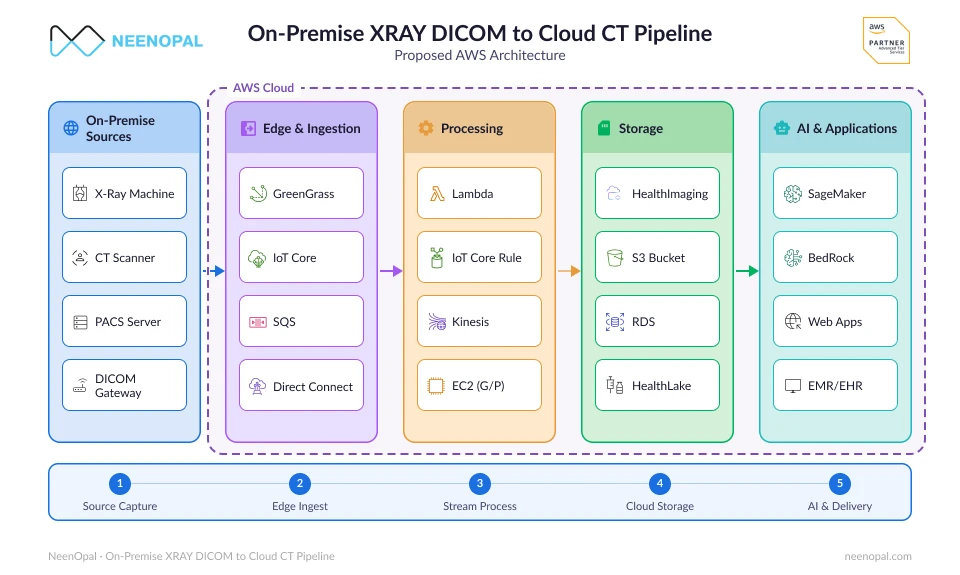
The diagram illustrates the end-to-end cloud pipeline, covering clinic-side DICOM capture via DICOM Gateway and IoT Core, secure ingestion into AWS through SQS and Lambda, staging via Amazon S3, compliant DICOM storage via AWS HealthImaging, and GPU-accelerated 3D reconstruction on Amazon EC2, with outputs delivered to web applications and EMR/EHR systems.
Solutions
NeenOpal initiated a structured discovery and architecture design engagement to lay the foundation for a modern, cloud-native imaging pipeline, built on AWS and centered on AWS HealthImaging for scalable, compliant DICOM management.
Discovery & Requirements Alignment
NeenOpal conducted detailed workshops with our client's team to map end-to-end imaging workflows, evaluate DICOM cloud migration requirements, and identify clinic-side connectivity constraints. Connectivity patterns including DICOM gateways, AWS IoT Core, Greengrass, and direct API-based submission were assessed to ensure secure, HIPAA-compliant data movement. PHI handling and encryption requirements were analyzed to align the dental imaging cloud pipeline with HIPAA standards. GPU compute needs for the proprietary C++ reconstruction engine were evaluated to identify suitable AWS instance families for medical image processing at scale. A proof of concept was conducted to validate DICOM ingestion paths, AWS HealthImaging compatibility, and GPU-triggered processing, confirming the feasibility of the on-premise to cloud migration ahead of prototype development.
Prototype Pipeline Development
Based on Phase 1 findings, NeenOpal built an end-to-end dental imaging cloud pipeline encompassing S3 staging, SQS metadata queuing, AWS HealthImaging ingestion, and GPU-based medical image processing on EC2. Our client's proprietary reconstruction algorithm was containerized for cloud integration, secure return workflows for 3D outputs were established, and baseline observability and error handling were implemented.
Scaling and Productization
The prototype was hardened into a production-ready pipeline with full HIPAA-compliant cloud architecture controls, automated deployments, and multi-clinic support. GPU autoscaling and pipeline throughput were optimized for cost and performance efficiency. Comprehensive documentation and knowledge transfer were delivered to support long-term operational independence, completing the on-premise to cloud migration at full production scale.
Services
 AWS HealthImaging
 Amazon S3
 Amazon SQS
 AWS Lambda
 Amazon EC2
 AWS IoT Core
 AWS Greengrass
 Amazon ECS
Benefits

Centralized, Scalable Architecture
A cloud-native dental imaging cloud pipeline on AWS eliminates the need for on-premise servers at each clinic, enabling centralized compute, storage, and processing that scales with clinic growth, a true on-premise to cloud migration outcome.

HIPAA-Compliant Cloud Architecture
The proposed architecture enforces PHI encryption, secure transport, and audit-ready data flows across every stage, establishing a fully HIPAA-compliant cloud architecture that significantly reduces regulatory and data security risk.

GPU-Powered 3D Reconstruction
By migrating the proprietary reconstruction engine to AWS GPU instances, GPU-based medical image processing becomes elastic and consistent, delivering faster, higher-quality results than on-premise hardware allows.

Validated DICOM Cloud Migration Path
The proof of concept confirmed the feasibility of DICOM ingestion paths and AWS HealthImaging compatibility before prototype development begins, de-risking the DICOM cloud migration and ensuring informed investment decisions.

Clear Path to Production
A detailed roadmap with defined scope, risks, and success criteria for Phase 2 and Phase 3 gives our client confidence in the implementation plan and a structured path to a fully operational, multi-clinic AWS cloud for healthcare environment.
Conclusion
By partnering with NeenOpal on a structured cloud discovery engagement, our client established a secure and scalable dental imaging cloud pipeline on AWS to replace its fragmented, clinic-level on-premise infrastructure. The engagement validated critical technical assumptions, defined a HIPAA-compliant cloud architecture for DICOM cloud migration, and produced a clear roadmap for prototype and production deployment, laying the groundwork for a modern, GPU-based medical image processing platform built for growth and powered by AWS HealthImaging.
FAQ
Explore key aspects of the solution, including AWS HealthImaging, HIPAA compliance, and performance optimization:
What is AWS HealthImaging and why was it chosen for this project?
AWS HealthImaging is a HIPAA-eligible service purpose-built for storing, transforming, and managing medical imaging data at scale. It was chosen because it natively supports DICOM cloud migration, provides built-in compliance controls, and integrates seamlessly with other AWS services, making it the ideal foundation for a dental imaging cloud pipeline.
How does the proposed architecture ensure HIPAA compliance?
The HIPAA-compliant cloud architecture enforces PHI encryption in transit and at rest, implements strict access controls, and maintains audit-ready data flows across every stage of ingestion, GPU-based medical image processing, and output delivery. All connectivity patterns evaluated during discovery, including DICOM gateways and API-based submission, were assessed specifically for HIPAA-aligned data movement.
How does moving to AWS improve 3D reconstruction performance compared to on-premise servers?
On-premise servers are limited by fixed hardware capacity, leading to processing bottlenecks during peak imaging volumes. By migrating to AWS and leveraging GPU-based medical image processing on elastic EC2 GPU instances, our client can scale compute dynamically based on demand, delivering faster, more consistent 3D reconstruction results without the overhead of managing clinic-level hardware.
Authors


Case studies
Related case studies

NeenOpal's Digital Innovation for Addiction Treatment: Transforming Recovery
Our client, a leader in addiction treatment innovation, sought to improve traditional recovery models, which had a 50% success rate over 17 years. Fragmented care and inconsistent assessments hindered effectiveness. NeenOpal developed a scalable, cloud-native SaaS platform—the Digital Risk Stratification Tool using advanced analytics for data-driven risk assessment, real-time insights, and automated reporting. This solution enables personalized care plans, enhances recovery outcomes, and transforms addiction treatment into an insight-driven, predictive healthcare model.
Read case study
A leading Canadian Healthcare Company’s Data Journey with NeenOpal
A leading Canadian healthcare technology company is revolutionizing medical care access by providing real-time clinic wait times. NeenOpal's data analysis solution tackled challenges, transforming fragmented data into insights. This intervention improved clinic operations and user experiences, marking a shift in healthcare innovation.
Read case study
Building a Validated Conversational Sales Analyst on Amazon Quick for a Managed IT Provider
Our client, a managed IT services provider delivering all-inclusive computer, internet and help desk support to small and mid-sized businesses, already monitored sales opportunities across eight funnel stages in an established Power BI dashboard. Answering deeper questions about stage duration, win rates and trends still meant stacking filters and interpreting the resulting measures. NeenOpal extended that environment with a conversational AI Analyst Agent built on Amazon Quick, connected to the client's opportunity stage funnel dataset in Amazon RDS. Teams now ask questions in plain language and receive summaries, charts and the supporting SQL, cutting the time to a routine answer by 75% and the number of analysis steps by 60%. The depth sits in the foundation: a curated opportunity-stage data model, documented business rules, and answers reconciled with the existing Power BI dashboard month by month and filter by filter, which matched on every indicator tested. Power BI stays exactly where it was.
Read case study
Building a Multi-Capability Retail Customer Support Assistant on Amazon Connect
Our client, a large retail group selling consumer goods, approached NeenOpal for a customer support assistant for its website, along the lines of the conversational shopping assistants the major online marketplaces now offer. The brief arrived as an exhaustive list of capabilities the assistant had to cover, spanning product research, cart building, order tracking, warranty and complaint handling, post-purchase care, and escalation to a human agent. NeenOpal built the assistant as a working proof of concept on Amazon Connect, the first time the team had taken Connect into a customer engagement. A conversational layer handles the dialogue, a governed tool layer gives the assistant controlled access to customer and product information, verified sign-in gates anything account specific, and a handover path passes the full conversation to a live agent when a person is needed. The build went from brief to working demonstration in four weeks.
Read case study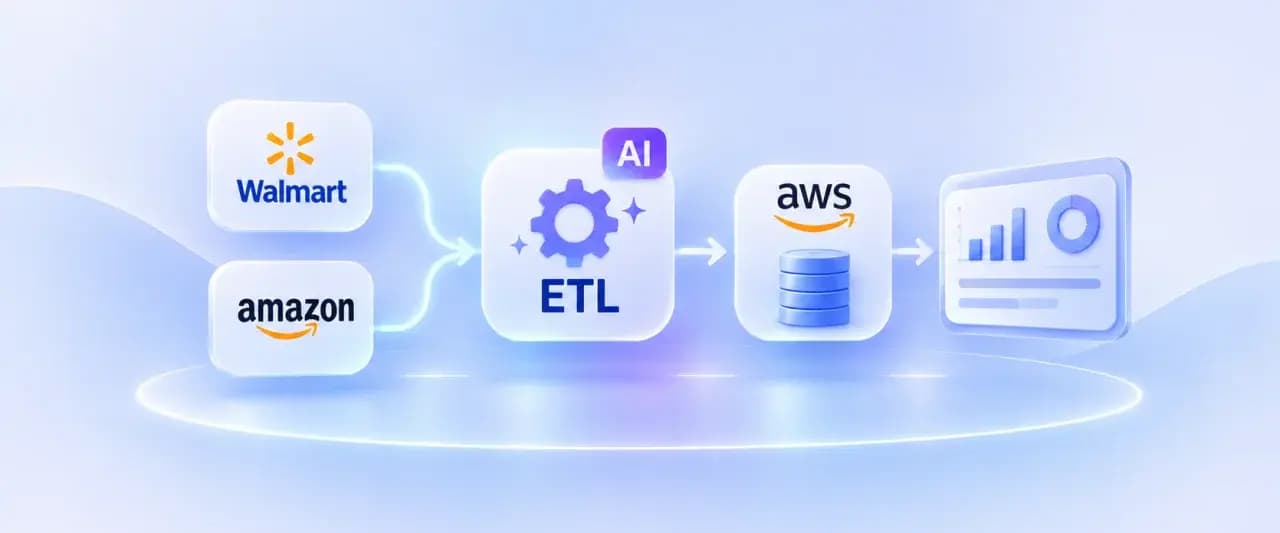
AI-Augmented ETL for Automating Multi-Portal Retail Reporting on AWS
A consumer beauty and personal care brand needed to bring its Walmart and Amazon supplier and performance data into a single AWS RDS PostgreSQL database. Walmart's data was split across a standard supplier API and three separate reporting portals (Retail Link, Scintilla, and Supplier One), each with its own authentication, file formats, and update cadence. NeenOpal designed a hybrid ETL platform with two ingestion paths running in parallel: an orchestrated API pipeline for the data Walmart exposes directly, and an AI-driven report retrieval pipeline for the data that fell outside the scope of the client's existing API access. Both paths converge on a shared Glue transformation layer, a common S3 staging area, and a single PostgreSQL database, with a separate one-time Spark job bringing in Amazon Vendor Central's historical data. The result is a single, config-driven system rather than a set of one-off integrations.
Read case study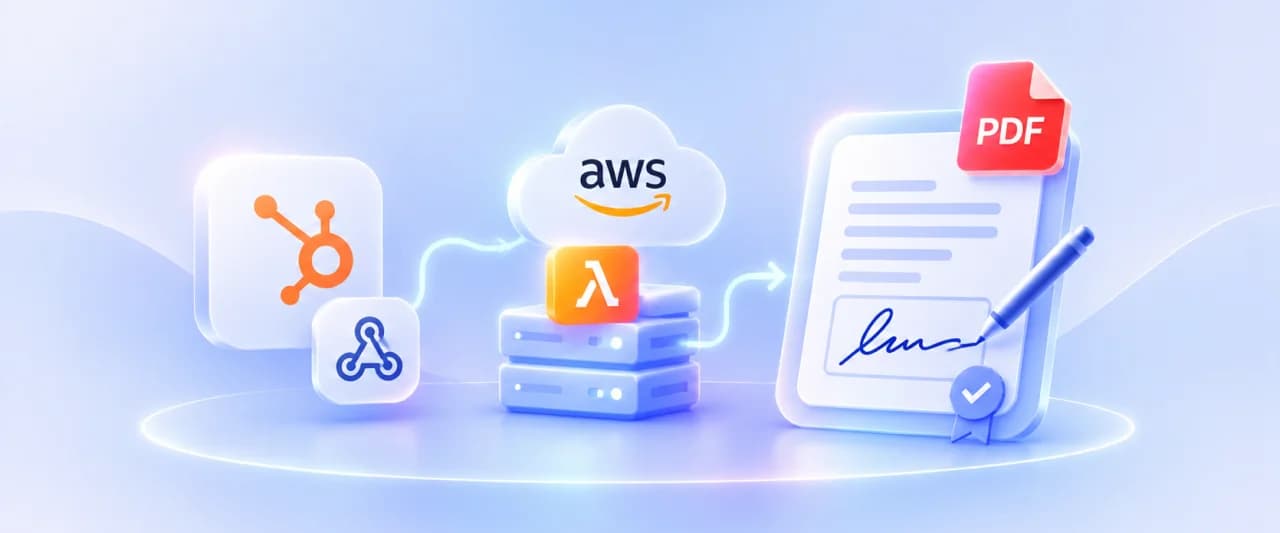
Automating Signed Credit Application PDFs with HubSpot Webhooks and AWS Serverless
Our client, a managed technology services provider, partnered with NeenOpal to automate the business credit application its customers complete when applying for credit terms. Until then the whole process ran over email. The team sent the customer a Word form as an attachment, the customer filled in their details and emailed it back, and someone then filed the completed form against the right account in Salesforce. Every application involved a round of back and forth correspondence, manual handling at both ends, and a record that existed only as a document attached to an account. NeenOpal designed and delivered HubSpot form to PDF automation on AWS, a serverless document automation pipeline that replaced the email exchange with a single link on the client's website. A customer opens the form, enters their details, and signs, and a branded PDF is generated automatically, emailed to the address captured on the form and to the client's own team, and archived in encrypted Amazon S3, while the submission itself is recorded field by field in HubSpot. Nobody sends a form out, chases it back, or files it by hand.
Read case study