

Overview
A well-established enterprise leveraged Microsoft Dynamics 365 Finance as its core system for managing general ledger, accounts payable, accounts receivable, and financial reporting. While the ERP system supported day-to-day accounting processes, the finance leadership team required a scalable analytics platform to enable faster financial close, historical analysis, and audit-ready reporting.
7X
faster financial reporting queries
55%
reduction in month-end close effort
99.9%
data availability for finance reporting
Customer Challenges
The client’s finance teams encountered multiple limitations when using Dynamics 365 Finance data for analytics and reporting. While the ERP system supported core accounting processes, it was not optimized for scalable analytics or close-cycle reporting demands.

Manual and Time-Consuming Financial Reporting
Month-end and quarter-end financial reports relied heavily on manual data extraction from Dynamics 365 Finance. This increased reporting effort, extended close timelines, and introduced the risk of human error during critical reporting periods.

Lack of Standardized Finance Metrics
In the absence of a centralized and governed finance data model, different teams reported financial metrics using inconsistent definitions. This led to discrepancies across reports, reduced confidence in financial numbers, and additional reconciliation efforts for finance leadership.

ERP Performance Constraints During Close Cycles
Running finance-heavy analytical queries directly on the ERP system had an impact on system performance, particularly during peak close periods. This created operational bottlenecks and limited the ability of finance teams to analyze data without affecting transactional workloads.
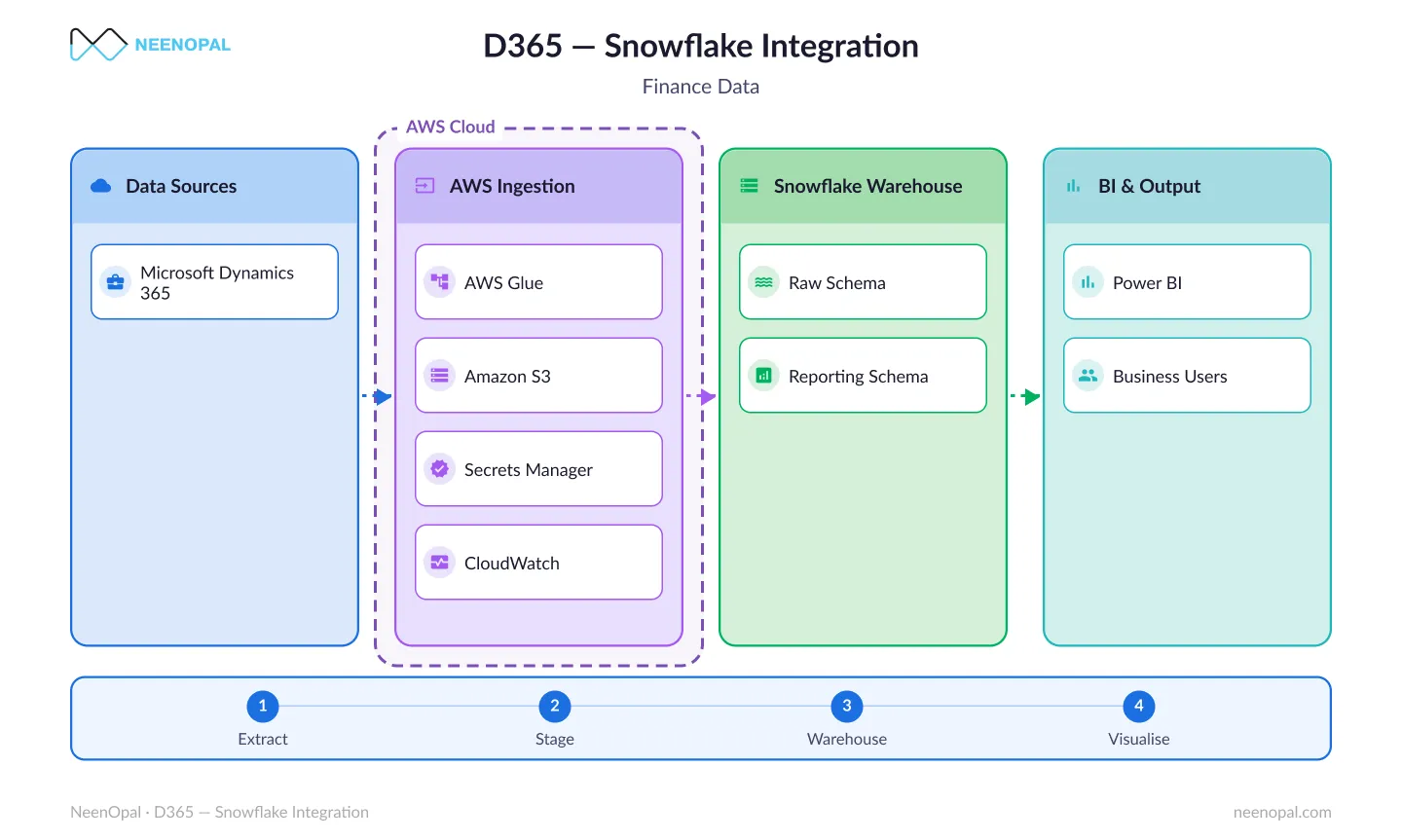
Finance Data Integration Architecture: Dynamics 365 to Snowflake on AWS
A scalable AWS-based ETL architecture extracts financial data from Dynamics 365 Finance, stages it in Amazon S3, transforms it within Snowflake, and delivers governed financial insights through Power BI dashboards for faster reporting and audit-ready analytics.
Solutions
To enable scalable, reliable, and audit-ready financial analytics, a cloud-based ETL and analytics architecture was designed to integrate Dynamics 365 Finance data into Snowflake.
01.
Data Extraction from Dynamics 365 Finance
Finance data was extracted from Dynamics 365 Finance using REST APIs orchestrated through AWS Glue. The pipelines captured core financial entities, including general ledger, journals, and transactional finance data, with both full and incremental loads to support efficient data processing.
02.
ETL Orchestration and Data Processing
Automated ETL workflows were implemented to ensure reliable and repeatable data movement. Incremental processing reduced load times and enabled near real-time data availability for finance reporting, without impacting ERP performance.
03.
Persistent Staging Layer on Amazon S3
Raw financial data was loaded into Amazon S3, creating a durable and auditable staging layer. This approach preserved source-level data, supported reprocessing and data replay, and provided a clear lineage from raw to curated datasets.
04.
Snowflake Data Modeling and Transformation
Data was loaded into a Snowflake Raw schema using Snowflake storage and file integrations. Stored procedures were used to transform raw data into curated, analytics-ready datasets within the Snowflake Reporting schema, applying standardized business rules and financial calculations.
05.
Finance Data Consistency and Governance
A centralized Snowflake reporting schema ensured consistent definitions for key finance metrics such as balances, revenues, expenses, and period-based calculations. This eliminated metric discrepancies and established a single source of truth for financial reporting.
06.
ower BI Reporting and Analytics Enablement
Power BI was used as the analytics layer to deliver interactive finance dashboards and reports. Semantic models were designed with standardized KPIs and financial hierarchies to support: 1. P&L, balance sheet, cash flow, and trial balance reporting 2. Slicing by period, legal entity, cost center, and account hierarchy 3. Period-over-period, budget vs. actual, and year-to-date analysis using dynamic calculations
07.
Security, Monitoring, and Controlled Access
Credentials were securely managed using AWS Secrets Manager, while pipeline execution and failures were monitored through Amazon CloudWatch. Role-based access controls were enforced across Snowflake and Power BI to ensure finance stakeholders accessed only authorized datasets.
08.
Handling Complex Financial Data Structures
The centralized analytics model preserved relationships across Dynamics 365 Finance entities, enabling accurate rollups, hierarchical reporting, and reliable financial analysis in Power BI.
Modernize Your Finance Reporting by Integrating Dynamics 365 Data with Scalable Cloud Analytics Platforms
Talk to Our ExpertsServices


Benefits

Faster Financial Close
Automated ETL pipelines and analytics-ready datasets significantly accelerated month-end and quarter-end close cycles, reducing manual effort and reporting delays for finance teams.

Single Source of Truth for Finance
Centralized and governed finance data in Snowflake ensured consistent definitions across entities, periods, and account hierarchies, improving confidence in reported numbers.

Improved ERP Performance
Finance-heavy analytical workloads were offloaded from Dynamics 365 Finance, preventing performance degradation during close cycles and ensuring uninterrupted transactional operations.

Improved finance visibility
Real-time KPIs across revenue, costs, cash flow, budgets, and variances provided finance leaders with timely insights to support faster and more informed decision-making.

Audit Reporting and Traceability
End-to-end data lineage from raw data in Amazon S3 to curated datasets in Snowflake enabled historical traceability, supporting audit investigations and compliance requirements.

Scalable Analytics Foundation
The cloud-based architecture provided a future-ready platform that can easily scale to support business growth, acquisitions, and advanced analytics use cases.
Conclusion
By integrating Dynamics 365 Finance data into Snowflake using a scalable AWS-based ETL architecture, the organization transformed its financial reporting and analytics capabilities. The solution improved close-cycle efficiency, ensured data consistency, and enabled audit-ready reporting, while laying a strong foundation for scalable and advanced finance analytics in the future.
FAQ
Dynamics 365 Finance to Snowflake Integration: Frequently Asked Questions
What are the benefits of integrating Dynamics 365 Finance data with Snowflake?
Integrating Dynamics 365 Finance with Snowflake enables organizations to move financial data into a scalable analytics platform. This allows finance teams to run complex reporting queries without impacting ERP performance, build centralized finance data models, and generate faster insights through BI tools like Power BI.
How does AWS Glue support Dynamics 365 Finance data integration?
AWS Glue orchestrates automated ETL pipelines that extract financial data from Dynamics 365 Finance using APIs. It processes and transforms the data before loading it into Snowflake, enabling reliable, repeatable, and scalable data movement for finance analytics and reporting.
Why is Amazon S3 used as a staging layer in the architecture?
Amazon S3 acts as a durable staging layer where raw data from Dynamics 365 Finance is stored before transformation. This enables data lineage, supports data replay or reprocessing, and ensures audit-ready traceability between source systems and curated analytics datasets.
Authors




Contact Us
We’d love to hear from you.
Lets discuss how we can transform your business with AI. Talk to our AI expert team. Lets do AI journey together.