
Overview
We partnered with a growing Ed-Tech SaaS provider that delivers cloud-based data infrastructure and analytics for K–12 school districts. The platform enables schools to unify their student information, learning systems, and performance data, providing real-time insights to educators and administrators. However, the provider faced significant challenges in integrating data from multiple systems, ensuring data quality, and delivering consistent, scalable analytics experiences. To address this, we implemented a modern data foundation using Microsoft Fabric, Synapse Analytics, and Power BI, completely transforming how education data is managed and visualized.
30%
Faster Insights
60%
Fewer Support Tickets
25%
Cost Savings
Customer Challenges
The Ed-Tech provider faced multiple hurdles that limited scalability and data reliability across districts. These challenges not only slowed reporting but also reduced the trust and usability of analytics for educators.

Fragmented Data Sources
Schools used separate systems for attendance, grades, LMS content, assessments, and behavior tracking. Integrating this data manually resulted in high maintenance costs and inconsistent metrics.

Manual and Delayed Reporting
Each district used its own reporting methods, often relying on spreadsheets and legacy BI tools. Report generation took days, and real-time insights were out of reach.

Data Quality and Governance Issues
Lack of automated validation led to frequent data gaps, missing fields, and duplication, causing educators to lose trust in the accuracy and reliability of the reports.

No Interoperability Framework
Without adherence to common education data standards (e.g., Ed-Fi, OneRoster), every district integration required custom mapping, slowing down onboarding.
Modern Education Analytics Architecture on Microsoft Fabric
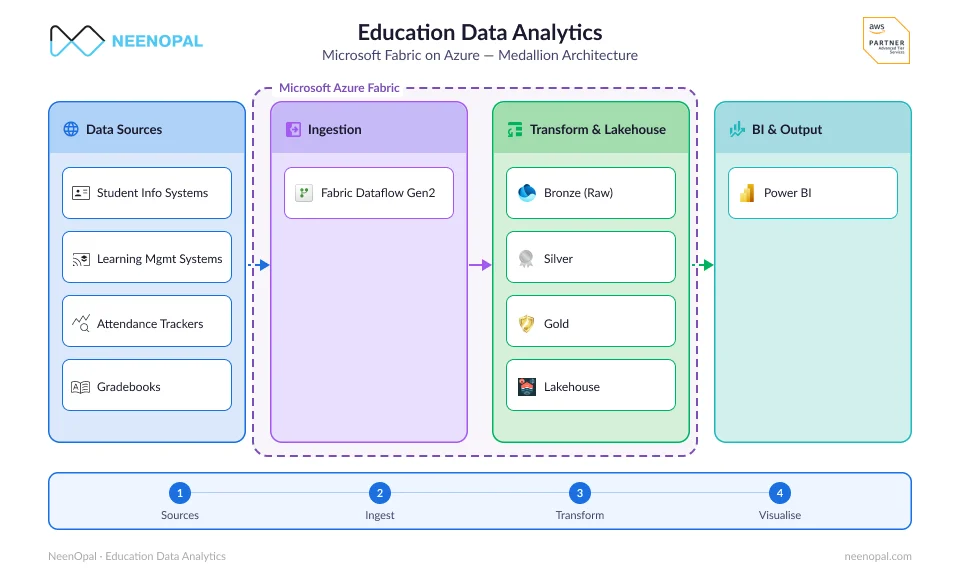
Dataflows and pipelines ingest district data into a Lakehouse model, enabling governed analytics and real-time insights.
Solutions
We designed and deployed a centralized data and reporting platform based entirely on Microsoft’s modern analytics stack.
01.
Data Ingestion & Integration
Using Microsoft Fabric Dataflows Gen2 and Pipelines, we integrated multiple education systems, including SIS, LMS, attendance trackers, and gradebooks. All data was consolidated into a unified data lake in OneLake, storing raw, cleansed, and modeled datasets. Following open standards like Ed-Fi and OneRoster ensured schema-aligned pipelines, promoted consistency, and significantly reduced onboarding time for new districts.
02.
Data Modeling & Transformation
A Lakehouse medallion architecture (Bronze → Silver → Gold) was applied using Microsoft Fabric’s native features. Within this framework, we modeled core education entities such as Students, Courses, Enrollments, Attendance, Assessments, and Teacher Performance. To support reporting needs, a semantic layer was built in Synapse Data Warehouse, enhanced with views and stored procedures optimized for Power BI.
03.
Reporting & Dashboards with Power BI
Power BI role-based dashboards served different users. District administrators tracked enrollment, attendance, and dropouts. Principals monitored performance, teacher utilization, and course completion. Educators followed student progress and assignments. State officials reviewed compliance, equity, and outcomes. Dashboards were embedded in the web portal, providing secure, real-time access for stakeholders.
04.
Governance & Quality Assurance
To maintain security and trust, Role-Based Access Control (RBAC) was implemented through Azure Active Directory. Data validation layers were added within pipelines to automatically flag missing records or schema mismatches before processing. Additionally, Microsoft Fabric’s governance features were used to monitor data lineage, refresh history, and provenance, ensuring accuracy, transparency, and reliability across reports.
Unify Fragmented Education Systems into a Secure, Scalable, and Real-Time Analytics Ecosystem with Microsoft Fabric
Schedule a Strategic ConsultationServices


Benefits

Unified Student Data Platform
Eliminated siloed data and established a single source of truth for academic, behavioral, and administrative insights.

Real-Time Stakeholder Dashboards
Delivered district-wide dashboards with near real-time refresh cycles, improving decision-making speed and accountability.

Faster Time-to-Insights
Reporting cycles were reduced from multiple days to under an hour, enabling analysts to focus on deeper insights instead of manual preparation.

Reduced Support Tickets
Standardized, governed dashboards minimized confusion and eliminated inconsistencies in district reports.

Scalable & Standards-Based Design
Integration with Ed-Fi and OneRoster simplified onboarding for new districts, requiring minimal custom development.

Cost Optimization
Replacing third-party ETL and visualization tools with native Microsoft Fabric services significantly lowered operational expenses.
Conclusion
With Microsoft Fabric and Power BI, this Ed-Tech provider was able to deliver a scalable, governed, and standards-aligned data analytics platform for school districts. Stakeholders now have the tools to monitor student performance, ensure equity, and make timely, data-driven decisions, all within a unified, modern Microsoft ecosystem.
FAQ
Frequently Asked Questions About Building a Unified Education Data Platform with Microsoft Fabric
Why was Microsoft Fabric selected for this education analytics transformation?
Microsoft Fabric was chosen because it provides a unified, end-to-end analytics ecosystem that combines data ingestion, transformation, warehousing, governance, and visualization within a single platform. For an EdTech SaaS provider serving multiple districts, this eliminated the need for disconnected tools and reduced operational complexity. Fabric’s OneLake architecture ensured centralized storage, while its seamless integration with Power BI enabled real-time, governed reporting experiences across stakeholders.
How did the solution integrate data from multiple systems like SIS and LMS platforms?
The solution used Microsoft Fabric Dataflows Gen2 and Pipelines to systematically ingest and consolidate data from Student Information Systems, Learning Management Systems, attendance tools, assessment platforms, and gradebooks. By adhering to open education standards such as Ed-Fi and OneRoster, the integration process became structured and repeatable. This reduced custom mapping efforts, improved consistency across districts, and significantly shortened onboarding timelines.
What role did the Lakehouse architecture play in improving data reliability?
The Lakehouse medallion architecture provided a structured framework for managing data quality and usability. Raw data was first stored in its original format, then cleansed and validated before being transformed into analytics-ready datasets. This layered approach ensured that inconsistencies, missing fields, and duplications were addressed early in the pipeline. As a result, stakeholders gained greater trust in reports and analytics outputs.
Authors





Contact Us
We’d love to hear from you.
Lets discuss how we can transform your business with AI. Talk to our AI expert team. Lets do AI journey together.