
Overview
A rapidly growing startup was held back by its old monolithic app running on traditional virtual machines. Manual deployments, poor scalability, and high maintenance slowed down progress. NeenOpal helped modernize their setup by migrating to AWS Elastic Kubernetes Service (EKS) and building a fully automated CI/CD pipeline using Jenkins, ArgoCD, and GitOps. This improved agility, security, and overall efficiency.
60%
Faster Deployments
40%
Lower Infra Costs
100%
RBAC & Compliance
50%
Faster Issue Resolution
Customer Challenges
The client was operating on a legacy system that couldn’t keep pace with their growing business needs. Their existing infrastructure introduced multiple points of friction, making innovation slow and operations costly. A monolith to microservice migration became essential for growth.

Monolithic Bottlenecks
A tightly coupled, single codebase made it difficult to scale specific services independently or roll out new features quickly. Any update required deploying the entire application, increasing risk and reducing agility. This typical monolith pattern restricted business responsiveness.

Manual Deployments & Downtime
Deployments were manual, inconsistent, and prone to human error. Rollbacks during failures were slow and unreliable, often leading to extended periods of application downtime. This underscored the need for a monolith to microservices migration to bring stability and speed.

High Infrastructure Costs
The use of overprovisioned EC2 instances to ensure performance led to low resource utilization. Without auto-scaling or optimization, infrastructure costs were unnecessarily high and hard to justify as the business scaled.

Limited Observability
The absence of a centralized monitoring system meant teams had minimal visibility into system performance and application health. This led to slow incident detection, delayed responses, and increased mean time to resolution (MTTR).

Security Gaps
There were significant gaps in security practices, including no role-based access control (RBAC), lack of network segmentation, and absence of container image scanning. These left the system exposed to threats and hindered compliance with industry standards.
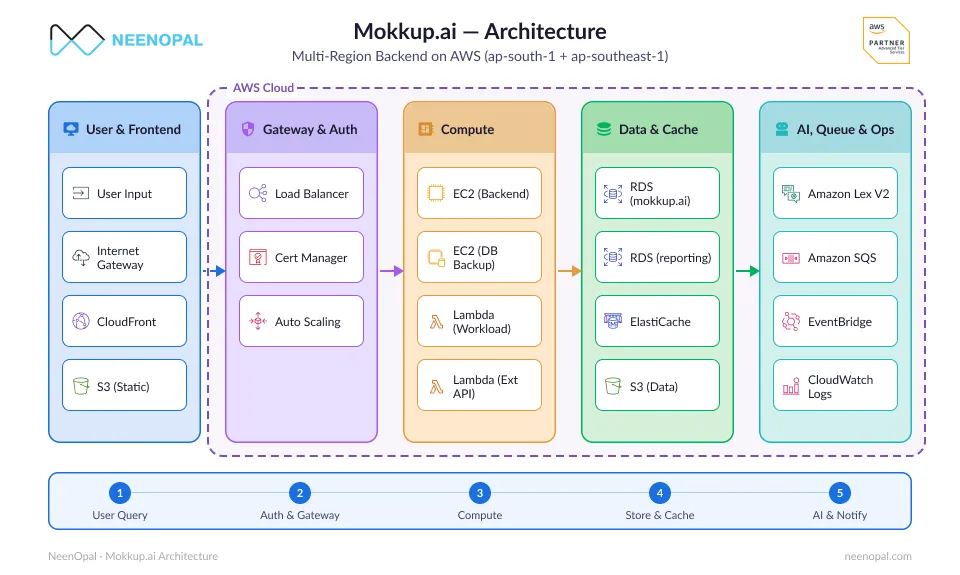
Microservices & CI/CD Architecture
A modern deployment framework showing the transition from a monolithic system to Kubernetes-based microservices with automated CI/CD for scalable, reliable releases.
Solutions
NeenOpal orchestrated a seamless migration to Kubernetes while embedding DevSecOps best practices and automation across the SDLC. The modernization initiative focused on scalability, cost-efficiency, observability, and security, setting the foundation for long-term growth.
01.
Containerized Microservices on AWS EKS
The monolithic application was refactored into lightweight, Dockerized microservices, each with independent scalability. Helm charts were used for consistent, repeatable deployments on Amazon EKS, enabling agile development and faster release cycles.
02.
CI/CD with Jenkins, ArgoCD & GitHub Actions
A fully automated CI/CD pipeline was built using Jenkins for builds, GitHub Actions for code integration, and ArgoCD for GitOps-based deployment. This enabled progressive rollouts, easy rollbacks, and reduced manual intervention across environments.
03.
Cost Optimization via Auto-Scaling & Spot Instances
Horizontal Pod Autoscaler (HPA), Cluster Autoscaler, and Spot Instance integration were implemented to dynamically scale resources based on real-time demand. This reduced idle capacity and significantly cut infrastructure costs.
04.
Full-Stack Observability
Monitoring was established across all layers using Prometheus and Grafana for metrics, CloudWatch for cloud-level insights, and the ELK stack for centralized logging. This provided real-time visibility, improved troubleshooting, and proactive alerting.
05.
End-to-End Security Hardening
Security was embedded throughout the stack with role-based access control (RBAC), network policies, AWS WAF, and AWS Secrets Manager. Automated container image scanning was also introduced to catch vulnerabilities early in the development cycle.
NeenOpal Blends Deep Cloud-Native Expertise with Proven DevOps and Security Frameworks.
Get StartedServices


Benefits

High Availability with 99.99% Uptime
Self-healing microservices and horizontal scaling ensured business continuity even under heavy load.

Accelerated Release Cycles
Fully automated pipelines cut deployment time by 60%, enabling faster innovation with zero-downtime rollouts.

Operational Cost Savings
Smart scaling, spot pricing, and resource optimization slashed infrastructure costs by 40%.
Conclusion
By transforming their legacy system into a modern, secure, and scalable architecture, NeenOpal enabled the client’s successful monolithic to microservices migration. With real-time observability, improved deployment speed, and lower operational costs, the client can now scale faster and innovate confidently, leaving the limitations of the monolith pattern behind.
FAQ
Get answers to common questions about modernizing monolithic systems with Kubernetes and automated CI/CD.
What challenge was the client facing?
The client’s monolithic application was difficult to scale, update, and deploy reliably.
What solution did NeenOpal implement?
NeenOpal re-architected the system into Kubernetes-based microservices and built an automated CI/CD pipeline.
What benefits did the modernization deliver?
The transformation improved scalability, reduced deployment time, and increased system resilience.
Authors



Contact Us
We’d love to hear from you.
Lets discuss how we can transform your business with AI. Talk to our AI expert team. Lets do AI journey together.