

Overview
Our client operates a network of nightlife and hospitality venues, where each location generates massive volumes of foot-traffic and point-of-sale (POS) data every day. Without a unified way to translate this data into meaningful insights, decisions around staffing, promotions, and operations were largely reactive, cross-venue performance comparisons were nearly impossible, and revenue opportunities remained hidden inside fragmented data systems. NeenOpal partnered with the client to build a scalable, multi-tenant venue intelligence platform on AWS that transforms raw POS and footfall activity into real-time, decision-ready insights at the venue, region, and network level.
99.9%+
ETL Job Execution Reliability
90%
Infrastructure Automated via Code
100%
Elimination of Manual Data Reconciliation
<5
Minutes End-to-End Data Latency
Customer Challenges
A Fragmented Data Estate Hiding Real-Time Performance Signals

Fragmented Data Ecosystem
Each venue operated on a different mix of POS systems and footfall sensors, all delivering data in varying schemas, formats, and cadences. This fragmentation made it nearly impossible to create a single, unified view of performance across the venue network or compare results consistently between locations.

Inconsistent Time and Revenue Logic
Differences in timezones, currency units, and sensor counting mechanisms across sources introduced significant complexity into the raw data. Without proper normalisation, any analytics built on top would have been unreliable, eroding stakeholder confidence in reported performance metrics.

Multi-Tenant Data Isolation
The platform had to enforce strict tenant-level separation, ensuring that every record, query, and dashboard remained scoped to a specific venue. Maintaining this isolation at scale was critical to preserving data trust, security, and regulatory posture across the venue base.

Lack of Decision-Ready Data at Scale
Raw operational data was not structured for analytics or reporting and required a clear transformation strategy to become clean, usable, insight-ready datasets. The system also had to handle high ingestion volumes across hundreds of venues while maintaining reliability across development, staging, and production environments.
Foot Traffic & POS Analytics Platform
Solutions
An End-to-End Multi-Tenant Venue Intelligence Platform on AWS
01.
Real-Time Data Unification
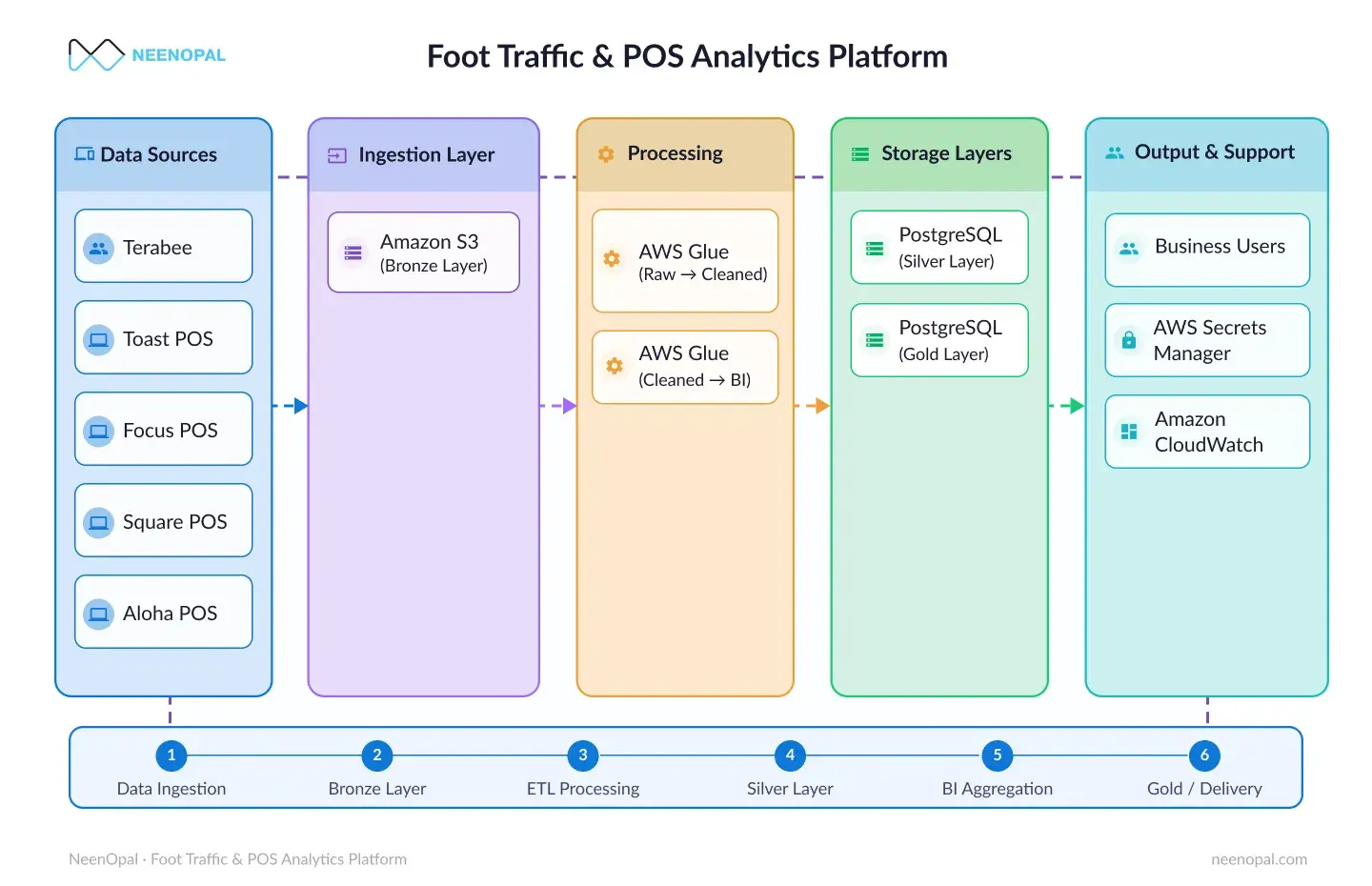
A centralised ingestion framework was implemented to bring data from POS systems and foot-traffic sensors into a single, tenant-aware pipeline. Event-driven workflows ensured that data was processed in near real-time, aligned tightly with venue operations and ready for downstream analytics.
02.
Medallion Architecture for Scalable Analytics
A layered medallion data architecture was introduced to progressively refine data from raw ingestion through to analytics-ready outputs. Standardisation of timestamps, currency formats, and sensor counting logic was applied consistently across the pipeline, ensuring reliability across every downstream use case.
03.
Tenant-Safe and Secure by Design
Tenant isolation was enforced across storage, processing, and query layers using structured data partitioning and strong access controls. Secure secret management and KMS-based encryption ensured that data remained fully segregated and protected at every layer of the platform.
04.
Fully Automated Data Pipeline
The entire pipeline, from ingestion through to reporting, was automated using event-driven scheduling and centralised monitoring. This minimised manual intervention while ensuring reliability and scalability across development, staging, and production environments deployed via Terraform.
Ready to turn fragmented venue data into real-time intelligence?
Get in touchServices


Benefits

Peak Hour Analysis
The platform surfaces high-traffic windows across each venue, allowing operators to align staffing, service capacity, and inventory planning to actual demand rather than guesswork. This translates directly into better customer experience and tighter cost control during the busiest periods of the week.

Footfall-to-Revenue Conversion
By correlating sensor data with POS transactions, the analytics layer measures how footfall translates into sales at each venue. This makes it possible to identify locations where traffic underperforms relative to potential and to target conversion-focused interventions with measurable impact.

Venue Benchmarking
Standardised metrics across the venue network enable consistent performance benchmarking between locations, formats, and regions. Operators can quickly identify outperforming venues, isolate the practices driving their results, and replicate them across the rest of the estate.

Demand Forecasting
Clean, normalised historical data feeds forecasting workflows that anticipate trends and support inventory and promotion planning. This shifts the operating model from reactive ordering and last-minute promotions to demand-led decision making rooted in trustworthy data.

Operational Optimisation
With a unified, tenant-safe view of performance across every venue, the team can quickly identify inefficiencies, monitor compliance, and improve margins at both the venue and network level. The same data foundation also positions the client to layer on AI-driven predictive capabilities in the future.
Conclusion
With NeenOpal's solution, the client successfully transformed fragmented venue data into a unified, real-time intelligence platform. By automating ingestion, standardisation, and analytics across diverse POS and sensor sources, the platform now bridges the gap between raw operational data and actionable insights, enabling venue operators to optimise performance, sharpen decision making, and unlock new revenue opportunities while laying the groundwork for future AI-driven and predictive capabilities.
FAQ
Frequently Asked Questions About the Venue Intelligence Platform
What is a multi-tenant venue intelligence platform and why does it matter?
A multi-tenant venue intelligence platform is a single analytics environment that securely serves many venues at once, with each venue's data fully isolated at the storage, processing, and query layers. For multi-location operators, it removes the need for separate per-venue stacks, while still ensuring that no record, dashboard, or query can leak between tenants. The result is a consistent, scalable analytics foundation that grows with the venue network without compromising data trust or security.
What is medallion architecture and how does it improve data quality?
Medallion architecture is a layered approach to data engineering, typically organised as bronze, silver, and gold tiers, where data is progressively cleaned and refined as it moves between layers. Raw POS and footfall data lands in the bronze layer, is standardised and normalised in the silver layer, and is exposed as analytics-ready datasets in the gold layer. This makes transformations transparent, auditable, and reversible, ensuring downstream dashboards always read from clean, trustworthy data.
How does the platform process data in near real-time across hundreds of venues?
The platform uses event-driven ingestion built around AWS Lambda, EventBridge, and Glue, so each new POS or sensor event triggers downstream processing automatically. Pipelines are designed to load only net-new data on each cycle, keeping end-to-end latency under five minutes while still scaling across hundreds of venues. This architecture gives operators intelligence that genuinely reflects what is happening on the floor right now.
Authors




Contact Us
We’d love to hear from you.
Lets discuss how we can transform your business with AI. Talk to our AI expert team. Lets do AI journey together.