
Overview
The client is a Chicago-based integrative healthcare provider operating multiple clinics across the Chicagoland area. They specialize in holistic, patient-centered care, offering a wide range of non-surgical and non-pharmaceutical services, including chiropractic care, acupuncture, functional medicine, and nutrition counseling. With a strong focus on convenience, transparency, and personalized wellness solutions, the organization supports high patient volumes while managing complex pricing structures across multiple insurance providers and service lines.
~85%
Reduction in Reporting Discrepancies
70%
Reduction in Reporting Preparation Time
100%
Data Platform Consolidation
Customer Challenges
The client lacked a unified view of its marketing performance due to data being spread across multiple platforms, including CRM, web analytics, advertising, and booking systems. While significant investments were made in digital marketing, the organization was unable to clearly track how marketing spend translated into actual patient appointments and revenue. The absence of a centralized data platform and standardized funnel tracking limited the client’s ability to measure ROI, understand patient acquisition journeys, and make informed, data-driven marketing decisions. The client required a scalable solution to consolidate marketing and patient data, enable cohort-based funnel analysis, and establish a single source of truth for marketing analytics.

Siloed Marketing and Patient Data
Critical data was distributed across platforms such as Salesforce Health Cloud, Google Analytics, Meta Ads Manager, and Zocdoc. There was no direct linkage between ad spend, lead generation, and booked appointments, resulting in fragmented insights. Inconsistent reporting across systems further created conflicting performance metrics and reduced trust in the data.

Lack of End-to-End Funnel Visibility
The organization did not have a centralized mechanism to track a patient’s journey from the initial ad click through to appointment booking. This limited the ability to analyze drop-offs at different funnel stages and restricted visibility into campaign-level and cohort-based conversion performance.

Manual and Offline Data Gaps
Offline lead sources and CSV-based datasets required manual uploads, leading to delays in reporting and incomplete historical records. This increased operational effort and introduced risks of data inconsistencies, further complicating marketing performance analysis.
Centralized Marketing Data Pipeline
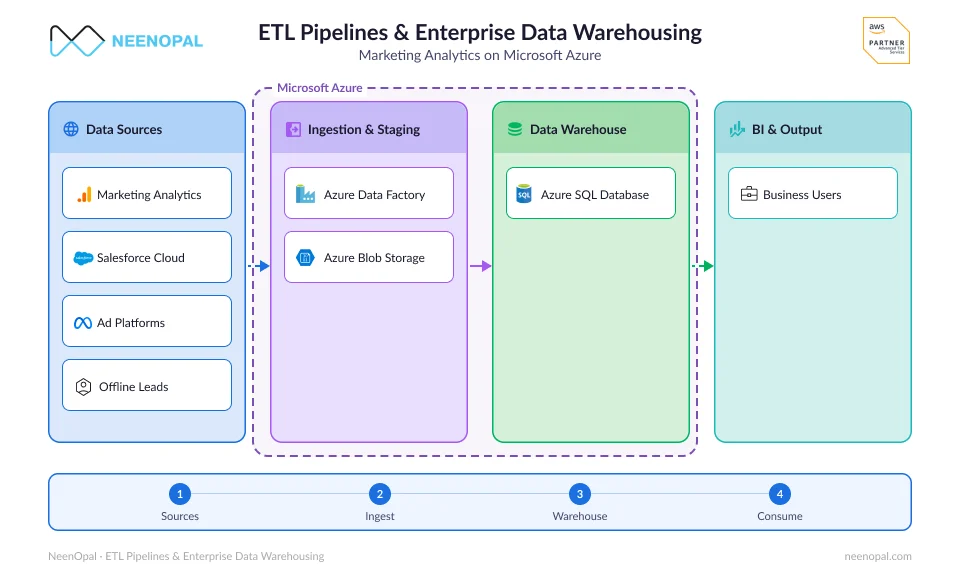
Data from CRM, ads, web analytics, and booking systems is integrated through Azure pipelines into a centralized warehouse, enabling automated processing, funnel tracking, and Power BI dashboards for clear marketing performance insights.
Solutions
To address fragmented marketing data and limited funnel visibility, a centralized and scalable analytics architecture was implemented using Microsoft Azure services. The solution automated multi-source data ingestion, unified marketing and patient datasets, and enabled cohort-based funnel tracking to deliver clear, ROI-driven insights into patient acquisition performance.
01.
Automated Data Ingestion and Orchestration
Azure Data Factory was implemented as the central orchestration layer to automate and manage end-to-end data workflows. Scalable pipelines were built to extract data from Salesforce Health Cloud, Google Analytics, and Meta Ads Manager through secure API integrations. Ingestion processes were also established for offline and flat-file sources such as Zocdoc CSV exports. This ensured scheduled, repeatable, and reliable data refreshes with minimal manual intervention.
02.
Centralized Staging and Data Warehouse Architecture
Azure Blob Storage was used as a landing and staging layer to store raw source data in its original format, supporting auditability, reprocessing, and historical analysis. Data was then transformed and modeled within Azure SQL Database to create a unified marketing and patient schema. This structure directly linked marketing interactions to patient records and appointment outcomes, establishing a single source of truth for performance analysis.
03.
Cohort-Based Funnel Analytics Enablement
Cohort-based tracking logic was designed to group leads by campaign, channel, and time period, enabling structured performance comparisons. This allowed the organization to monitor lead-to-appointment conversion trends over time and identify drop-offs at each funnel stage. Granular funnel visibility was established from initial awareness through final patient conversion, supporting more precise optimization of marketing investments.
Turn Your Marketing Data into Measurable Growth
Start Your Data JourneyServices


Benefits

360° Marketing Visibility
Data from CRM, advertising platforms, web analytics, and booking systems was consolidated into a single, unified view. This provided true end-to-end funnel visibility from the first marketing touchpoint through to appointment booking. Reporting discrepancies across platforms were reduced by approximately 85 percent, significantly improving data trust and alignment across teams.

Improved Marketing ROI and Decision-Making
The solution enabled accurate attribution of patient conversions to specific marketing channels and campaigns. With clear visibility into performance, the organization was able to reallocate budgets toward high-performing channels, improving return on marketing investment and driving more informed, data-driven decisions.

Automation and Operational Efficiency
Manual data aggregation and spreadsheet-based reporting processes were eliminated through automated pipelines. Reporting preparation effort was reduced by 70 percent, and marketing performance metrics became available in near real time, enabling faster analysis and action.

Scalability and Governance
Azure SQL Database was established as the centralized single source of truth for marketing and patient analytics. The architecture was designed to scale seamlessly with new clinics, channels, and data sources, while improving data consistency, auditability, and long-term maintainability.
Conclusion
By implementing a unified marketing analytics platform on Microsoft Azure, the client successfully transitioned from fragmented, manual reporting to a centralized, automated, and insight-driven marketing ecosystem. The solution provides full visibility into the patient acquisition funnel, enables cohort-based performance tracking, and delivers reliable ROI measurement across channels. With a scalable and governed data foundation in place, the organization is now well-positioned to optimize marketing investments, forecast growth trends, and support continued expansion across clinics and service lines.
FAQ
Here are some common questions about implementing a unified marketing analytics platform for healthcare organizations:
How does a unified marketing analytics platform improve healthcare marketing performance?
A unified platform consolidates data from CRM systems, advertising platforms, web analytics, and booking tools into a single view. This enables organizations to track the complete patient acquisition journey, measure campaign ROI, and make data-driven marketing decisions.
Why is end-to-end funnel visibility important in healthcare marketing?
End-to-end funnel tracking allows organizations to understand how patients move from the first marketing interaction to appointment booking. This helps identify drop-off points, optimize campaigns, and improve conversion rates across marketing channels.
How does automated data integration improve marketing reporting?
Automated pipelines eliminate manual data aggregation and ensure consistent, timely updates from multiple marketing platforms. This improves reporting accuracy, reduces operational effort, and allows teams to focus on analysis instead of data preparation.
Can this analytics architecture scale as new clinics or marketing channels are added?
Yes. Cloud-based architectures built on platforms like Azure are designed to scale easily, allowing organizations to integrate new data sources, expand reporting capabilities, and support growing marketing operations without major infrastructure changes.
Authors



Contact Us
We’d love to hear from you.
Lets discuss how we can transform your business with AI. Talk to our AI expert team. Lets do AI journey together.