×
×
BI Dashboard Documentation Kit | End User Manual & Technical Guide
BI Dashboard adoption is concerningly low even today. A very plausible reason is that most never get documented for the team to comprehend. When there is no single source of truth, new team members struggle to onboard, handoffs get messy, and dashboards get abandoned. A well-created BI dashboard documentation kit solves these issues. This free download contains two ready-to-adapt documents that NeenOpal delivers as part of every BI engagement: a Business Intelligence Technical Documentation guide for IT and data teams and a dashboard user manual template for everyone. Together, they cover everything needed to run, adopt, and maintain a business intelligence solution confidently and independently, long after go-live.
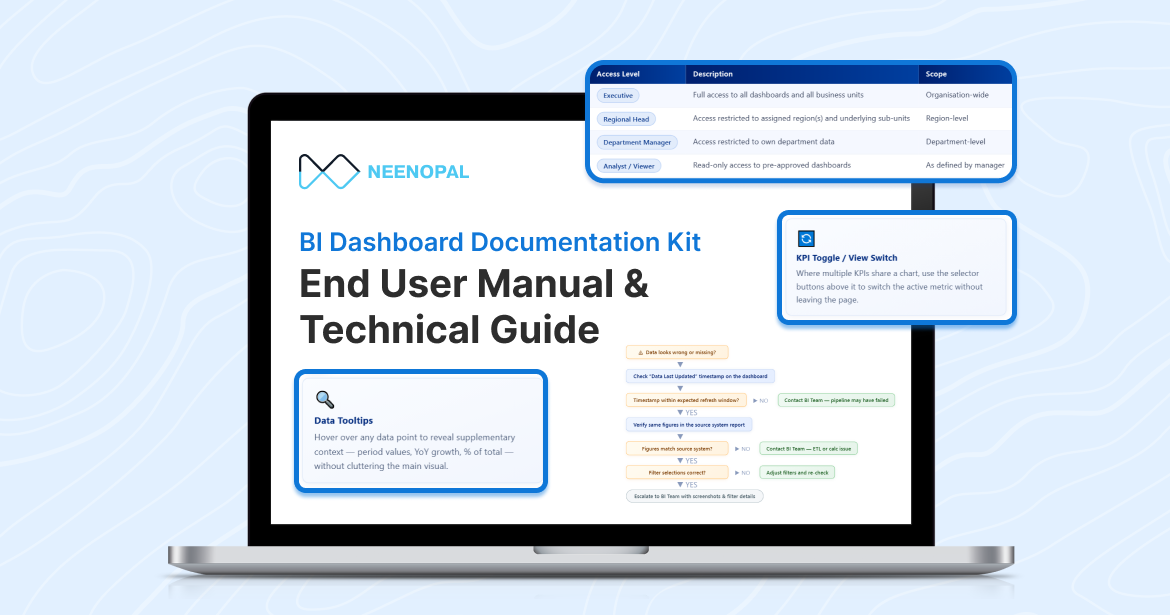


Key Sections of the BI Dashboard Documentation Kit
Given the complexity that comes with a new BI dashboard, an ideal BI Dashboard adoption kit needs to address the concerns of both technical and non-technical stakeholders. It should answer fundamental questions like what a metric means and how a filter works, while simultaneously helping technical teams on advanced insights such as KPI logic and pipeline architecture. To achieve that, this dashboard documentation template by NeenOpal contains two structural documents—a BI Dashboard User Manual and a Client Technical Documentation guide. Together, they help both business and technical stakeholders have a single source of truth and a reference framework for an entire dashboard lifecycle.

BI Dashboard User Manual
- Role-based access guide for every user type and permission level
- Source system and data refresh schedule for five dashboard types
- Interpretive dashboard interface with every element mapped and explained
- Full filter reference with defaults, types, and behaviour
- Built-in features for tooltips, KPI toggles, and data exports
- Official KPI definitions with formulas, and calculation logic
- Symptom-to-resolution troubleshooting guide with a five-tier escalation matrix
Client Technical Documentation
- Scope, integrations and where the boundary of delivery actually sits
- Architecture documented layer by layer
- Every module listed with its dependencies, because that's what breaks first
- Full data flow covering ingestion, transformation, and error handling
- Field-level definitions for everything surfaced in the dashboards
- KPI logic written to the formula, not just the label
- Enough for the client's IT team to operate independently post-handover
- Known issues, risks, and assumptions with impact and workarounds
- A version log that reflects what actually changed, and when
Who Will Benefit from This Documentation Kit?

BI Analysts

Dashboard Developers

IT Teams

Data Engineers

BI Managers
Conclusion
Dashboards that don't get used usually have one thing in common. Users weren't given enough to navigate them confidently, and the technical team didn't have enough to maintain them without going back to the delivery team. The build quality rarely explains abandonment. Documentation does. This kit reflects what NeenOpal has standardized across 100+ BI deployments on Tableau, Power BI, Looker, Snowflake, BigQuery, and Redshift. Adoption and reliability aren't separate goals to balance. Both come from documentation that's treated as part of delivery, not a closing formality. Download the kit, adapt it to your setup, and give your deployment what it needs to hold up after go-live.