It's official, and we're proud to say it: NeenOpal is now an ISO 42001-certified company.
INTERCERT conducted an audit of our Artificial Intelligence Management System (AIMS) against the requirements of ISO/IEC 42001:2023, and it completed successfully.
We are strictly compliant with ISO 27001 and SOC 2, and now AI governance is on that list. If you already trust us with security or privacy, AI risk management now runs through that same disciplined process.
The AI Risks This Standard Is Built to Catch
Generative and agentic AI systems fail differently than traditional software, and most GRC programs weren't designed to catch it. As per McKinsey's State of AI report, 51% of organizations using AI have already seen at least one negative consequence, with AI inaccuracy and explainability gaps among the most common culprits.
Here's what an ISO 42001 AIMS certification actually makes you build a response for:
- Bias creeps back in every time a model gets retrained or fine-tuned on new data, as fairness isn't a one-time checkbox
- Data drift, occuring when a production model looks fine at launch, then accuracy quietly slips as real-world inputs stop matching what it was trained on
- Hallucination and inaccuracy in generative outputs used in client-facing deliverables
- Explainability gaps, where stakeholders can't trace how a model reached a given output
Per McKinsey, fewer than a third of organizations have actually put its recommended AI governance practices into place. A third-party certification takes that discipline out of the "someday" pile into practice.
What the Audit Actually Covers
ISO/IEC 42001 is the world's first international standard written specifically for AI management systems. Unlike general security frameworks, it doesn't just check whether data is encrypted or access is controlled. It verifies whether an organization can govern AI systems across their entire lifecycle, from design and training through deployment and retirement.
An external auditor examined our documentation, controls, and operating evidence before issuing the certificate, which is what separates a marketing claim of "responsible AI" from a verified AI management system certification.
Specifically, the audit assessed our ability to:
- Identify and treat AI-specific risks, including bias, model drift, and unpredictable outputs, through a documented risk register reviewed on a fixed cadence
- Maintain human oversight over automated decisions. Every AI output that needs review follows a defined escalation path to a responsible reviewer.
- Document the AI system lifecycle end-to-end, including data sourcing and model selection, ongoing monitoring, and eventual decommissioning
- Show clients how models are evaluated and what data feeds them. That's the actual substance behind AI transparency and accountability, not a slide in a sales deck
- Run a plan-do-check-act cycle, meaning ethical AI oversight is checked on repeat, not signed off once and forgotten
What This Actually Changes for Clients Building AI with NeenOpal
Regulatory pressure on AI is accelerating faster than most internal governance programs can keep pace with. Gartner projects that fragmented AI regulation will extend to 75% of the world's economies by 2030, pushing global AI governance spending past $1 billion.
Working with an ISO 42001-certified AI company that also holds this responsible AI certification changes what a client's own procurement and risk teams have to verify manually:
- Vendor risk reviews move faster because our AI governance controls are already documented and audited.
- Fewer AI-specific incidents surface later, including bias complaints, model drift, data used without documentation- the stuff that normally shows up after launch, not before
- Our documentation is audit-ready already; it slots straight into your own regulatory or board-level AI governance reporting, no extra work needed
- One compliance contact instead of four. Security, privacy, and AI governance, covering ISO 27001, SOC 2, HIPAA, ISO 42001. All run through the same team now
How NeenOpal, an ISO 42001 Certified Company, Built Its Compliance Stack
NeenOpal built its AI governance framework deliberately, alongside ISO 27001 and SOC 2. Our compliance program already covered information security and data privacy, plus the data governance practices that keep AI outputs trustworthy in the first place. AI-specific governance was the one gap, and becoming an ISO 42001 Certified Company closed it.
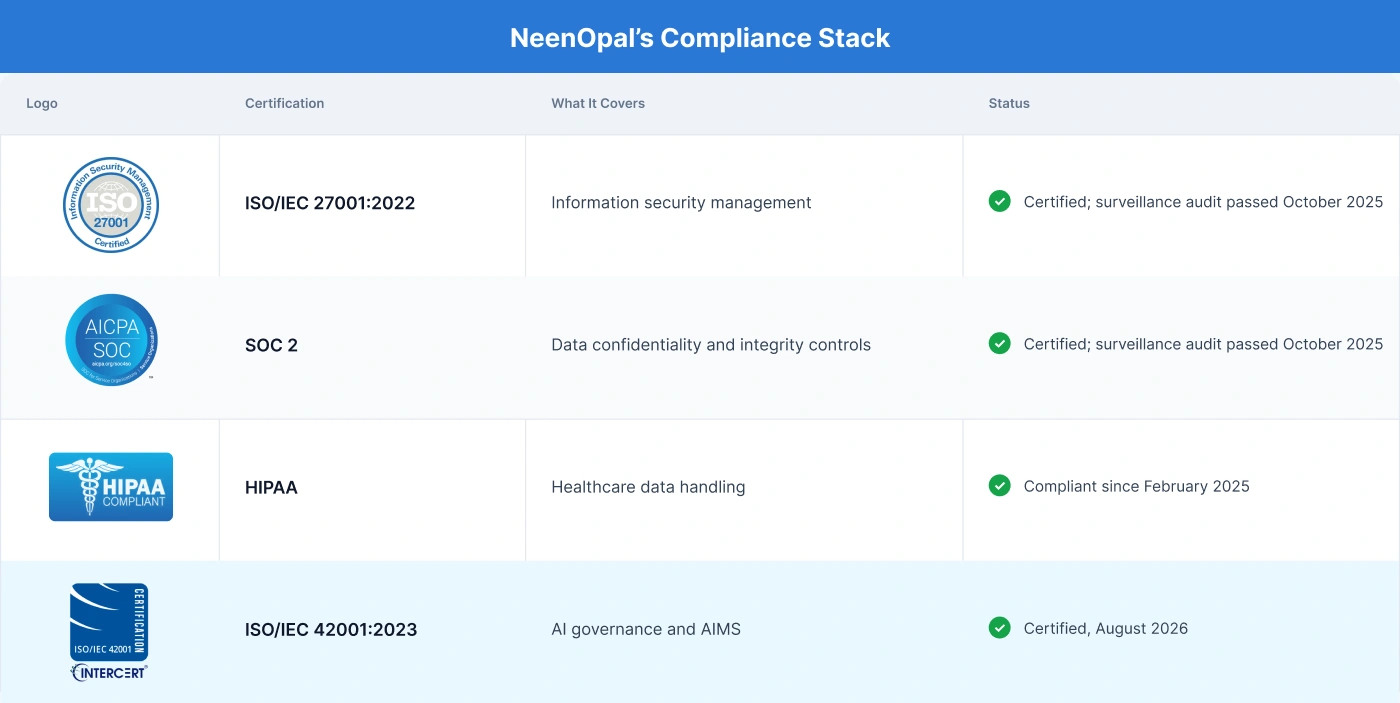
Several Annex A controls in ISO 42001 map directly onto controls NeenOpal already operates under ISO 27001, so our audit team extended existing evidence to AI governance. It inherits years of independently verified security and privacy controls, giving clients a compliance stack most AI vendors can't match.
Inside NeenOpal's Path to AIMS Certification
Getting to certification meant building an AI management system, not just writing a policy document. Our approach followed four stages:
- Gap assessment against Annex A controls to map what existing ISO 27001 and SOC 2 controls already satisfied, and where AI-specific controls were missing
- Policy and control design covering data governance, model risk management, human oversight, and incident response specific to AI systems
- Internal audit and evidence collection, testing controls against real project data across our BI and AI delivery engagements
- External certification audit by InterCert, culminating in ISO/IEC 42001:2023 certification in August 2026
We went through this same audited rigor to earn our AWS SaaS Competency and AWS AI Services Competency accreditations. This time it's pointed at AI governance instead of cloud delivery.
"Achieving ISO/IEC 42001 certification is an important milestone for NeenOpal and reflects our commitment to responsible AI."
said Himanshu Bahmani, Co-founder at NeenOpal. He added that as more organizations adopt AI, governance and risk management become essential to building secure, trustworthy AI solutions built for long-term impact.
Where This Takes NeenOpal Next
Being an ISO 42001-certified company doesn't close out our compliance roadmap; it sets the baseline for how we build AI systems going forward. Every new BI or applied AI and machine learning engagement at NeenOpal will now run through the same AIMS controls that got audited this year, not as a parallel checklist but as part of how the work gets delivered.
For a company built on turning data into decisions, being an ISO 42001-certified company means clients can trust the AI behind those decisions was governed as rigorously as the data feeding it. If your organization is evaluating AI vendors against governance and compliance criteria, connect with NeenOpal to see how our certified AIMS applies to your project.