
When NeenOpal and AWS put over 100 Sri Lankan CXOs in one room on a Friday evening in Colombo, the agenda wasn't to debate whether AI matters. That conversation is over. The only thing worth discussing: what does it actually take to move AI out of a slide deck and into something that shows up on a P&L?
That was the thesis behind the AI Catalyst Symposium– one of the most concentrated events around enterprise adoption in Sri Lanka to date. CFOs, COOs, CIOs, managing directors, and enterprise architects sat through roughly two and a half hours of practitioner-led sessions, live product demos, and numbers that made some people uncomfortable. This is what happened, and more importantly, what it means for the leaders who weren't in the room.
Why AI Projects Fail Before They Matter
Pavel Gupta, co-founder of NeenOpal, opened with a straightforward comparison that framed the entire evening.
Globally, over 72% of organizations were already using AI in at least one business function. In Sri Lanka, Pavel estimated the current figure at 10–15%. Sri Lanka has infrastructure, engineering talent, and a cost optimization that most markets would trade for.
The sharper number explains why AI projects fail:
-
85 to 90% of AI initiatives worldwide fail at the proof of concept stage and never move to production. Less than 10% of POCs become working systems.
-
Organisations that successfully scale AI see revenue growth 1.5x higher than competitors, but most organisations never get there because they never escape the POC loop.
The gap between 72% and 15% isn't a cause for embarrassment. It's a window. Pavel was direct about how long it stays open:
"Things that were taking days are being done by agents in minutes. The shift is already here. The question is no longer who is not going to adopt AI. The question is who is going to adopt and put that in production."
Companies leveraging AI in production are seeing 2 to 3x higher revenue growth in practice. The ones still piloting in 2026 will be chasing competitors who already rewired their operations two years earlier.
The Real Blockers Aren't Technical
Biswajit Das, AWS Head of AI for the region, reframed the conversation in a way that landed differently than most tech keynotes. A former bartender by training who now leads AI at one of the world's largest technology organisations, his point was deliberate: the tools exist. Every enterprise in that room could start building something useful tomorrow. So why aren't they?
The panel that followed put three blockers for enterprise AI adoption in Sri Lanka on the table –
- Anil Arora (Gen AI and ML Specialist, AWS),
- Daminda Perera (Group MD, Swissteck),
- Jayantha Rangamuwa (MD, Valuable Finance),
- Chanaki Mallikarachchi (Director of ICT, Sri Lanka Ministry of Digital Economy)
1. Data readiness
Mr. Perera was blunt: "If you don't get the right data set, you don't get the right data structures. What AI will give you will not deliver what you want."
Moving an AI POC to production demands more than a working model. The data foundation needs to be in order first. That's not a technology problem. It's an operational discipline problem, and it usually traces back to siloed teams that never had a reason to agree on a single source of truth.
2. People resistance
The fear of job displacement is real, and Perera has seen it across industries over two decades:
"Every time I switch industries, people say this is different; what we've been doing has worked."
The same resistance that greeted ERP systems, mobile apps, and cloud migration is now showing up around AI, and every enterprise AI case study tells the same story: leaders who make the connection between data capability and individual opportunity, rather than threat, move faster than those who don't address it at all.
3. Governance
Jayantha Rangamuwa put it cleanly:
"Governance is not a barrier. It's a necessity. It's the very foundation of AI adoption."
Financial services run on public trust and the custodianship of client funds. Accountability and transparency aren't optional design choices but the table stakes. The real AI model deployment challenge is calibration. Too much governance slows innovation. Too little increases risk.
On the policy side, Ms, Chanaki Mallikarachchi confirmed the Sri Lankan government is moving:
“An evolving AI strategy document, a Data Protection Authority that's operational, and a Cyber Security Act in final drafting. The private sector doesn't need to wait for perfect conditions. The conditions are forming now.”
But the message from this panel on AI production gap, to every AI for CIOs and digital transformation leader in the room, was clear: the blockers in your organisation are almost certainly human, not algorithmic.
One Sri Lankan Company Proved It Can Be Done
Singer Sri Lanka and NeenOpal have been on a joint data and AI journey since 2018. Eight years. 425 retail outlets. 49 years in Sri Lanka. Twenty years of ERP-quality data sitting in systems since 2004.
Mahesh Wijewardene, Managing Director of Singer Sri Lanka, described where it started:
"We have a hell of a lot of data, an enormous amount of data. How do we make the best out of it?"
Nobody used the word AI initially. Data became a strategic pillar first. The early investment was infrastructure –a data lake built across multiple subsystems, a single source of truth, and a cultural shift toward running meetings with data instead of anecdote. This is precisely why AI projects fail elsewhere: the foundation is skipped in favour of jumping straight to models.
Damitha Serasinghe, who heads IT at Singer, on what had to come before the technology:
"The behavioural culture was very important. The keenness of top management on how these things happen. That helped us move on with these projects."
Singer's path from AI POC to production wasn't accidental - it was the result of years spent getting the data infrastructure and organisational culture right before a single model went live.
The use cases that followed are not theoretical.
- RFQ Automation: Singer's B2B institutional sales channel was losing orders due to slow, inconsistent quotation responses– a problem where ownership was unclear, and follow-up was unreliable. AI agents now handle the entire RFQ pipeline: filtering incoming emails, matching SKUs, determining pricing, applying discounts, and presenting the completed proposal for human review. Response time dropped from 48 hours to under 2 hours. Singer keeps the human in the approval loop. The AI does the preparation.
- 56-Second Loan Origination: Biswajit Das demonstrated a bank running 7 agents plus one super-agent that handles the entire loan origination process from KYC, bank statement analysis, income verification, credit scoring, to approval logic. The whole process: 56 seconds. Traditional processing time at most banks: 7 days minimum. The agents handle everything except physical verification.
- Supply Chain Control Tower Built in 3 Weeks: An AWS customer in food distribution deployed 5 people (2 demand planners, 3 supply planners) to build a full supply chain risk monitoring platform in three weeks. The system tracks at-risk shipments across hundreds of distribution centres in real time, recalculates ETAs accounting for weather events, port disruptions, and carrier performance, and recommends rerouting options, including the cost difference between Plan A and Plan B. Previously, 23 people did this manually across 20 Excel sheets.
- Insight IQ for Executives: When a CXO needs data that isn't available in any existing dashboard, they typically wait days while the IT team builds a report. NeenOpal's Insight IQ product answers those questions directly with natural language against live company data, with variance explanation and root cause included.
These results where hours cut to minutes, weeks are cut to seconds, and dozens of people replaced by five, are what enterprise AI ROI looks like when it moves beyond the pilot stage.
These are not results from a lab in Singapore. They're the clearest evidence yet of what enterprise AI adoption in Sri Lanka can deliver, running in production today, built on Sri Lankan data.
Mahesh Wijewardene’s advice to every leader still evaluating:
"Don't try to rebuild your company to suit AI. Get AI to do the best out of your existing processes and systems."
What AI Costs and What Not Starting Costs More
Every finance leader in the room had one unasked question. Anish Gangwal and Raghav Kadia from NeenOpal answered it directly–breaking down exactly what an AI query costs to run, what the ROI math looks like in practice, and why the cost of waiting compounds faster than most finance teams model for.
Watch the segment for the full breakdown, including the vehicle loan example that made the numbers real.
Key Takeaways for Enterprise Leaders
Ten things worth taking into the next board meeting from AI Catalyst Symposium 2026.
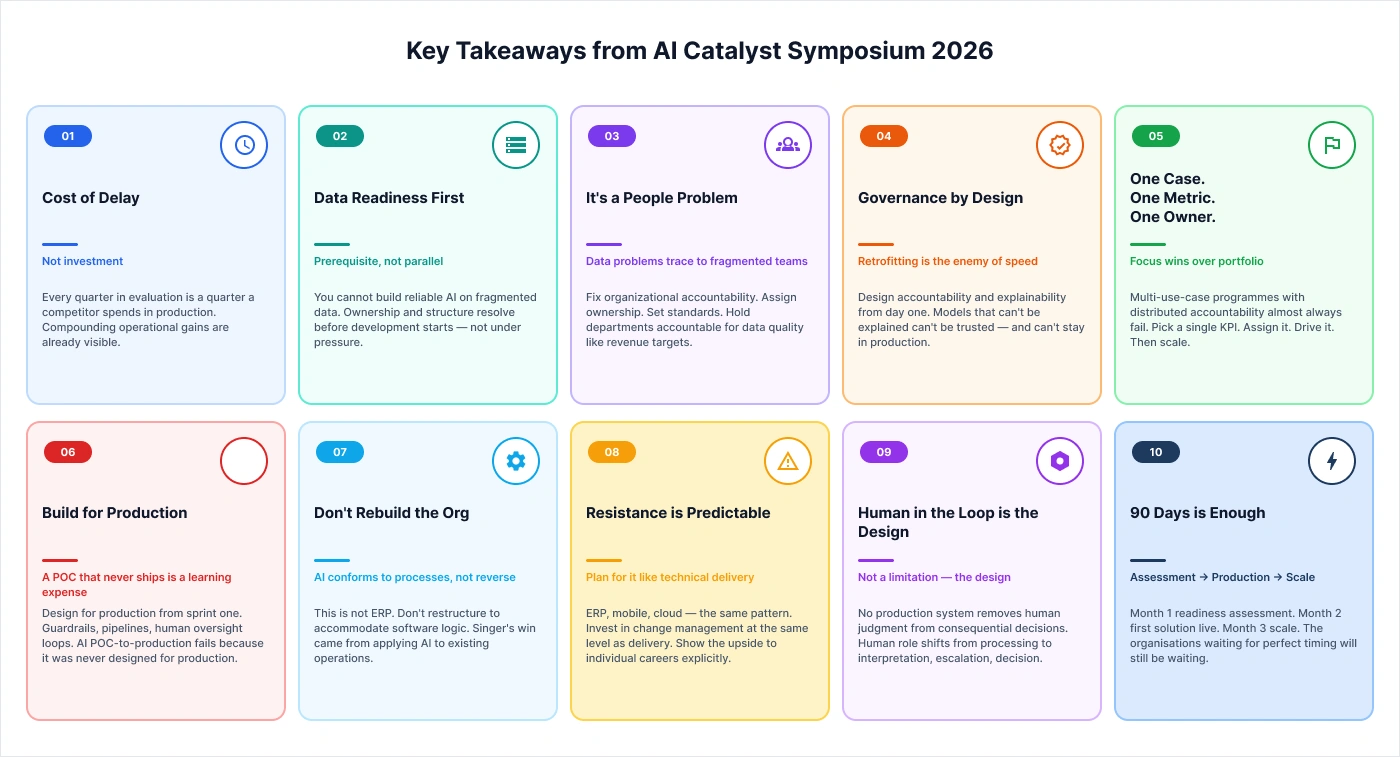
1. Stop sizing the AI investment. Start sizing the cost of delay. Every quarter spent in evaluation mode is a quarter a competitor spends in production. The compounding effect on operational efficiency isn't hypothetical, it's already showing in revenue growth comparisons between AI adopters and laggards. For enterprise AI adoption in Sri Lanka, the gap between early movers and those still evaluating is starting to show.
2. Data readiness is a prerequisite, not a parallel task. You cannot build reliable AI on fragmented, inconsistent data. The governance of your data (who owns it) how it's structured (where it lives) has to be resolved before development starts, or you'll be fixing it under production pressure.
3. Your data problem is almost always a people problem first. Fragmented data traces back to fragmented teams. The fix is an organisational decision. Assign ownership. Set standards. Hold departments accountable for data quality the same way they're held accountable for revenue targets.
4. Governance isn't the enemy of speed. Retrofitting it is. Design accountability and explainability into your AI systems from day one. In regulated industries like finance, healthcare, manufacturing, this isn't optional. But even outside regulation, models that can't be explained can't be trusted, and models that can't be trusted don't stay in production.
5. One use case. One metric. One executive owner. Multi-use case AI programmes with distributed accountability almost always fail. The organisations that move fastest pick a single KPI, assign it to one person, and hold them responsible for driving it with AI. Then they scale.
6. A POC that never reaches production is not an investment, but a learning expense. Design for production from the first sprint. Build with the guardrails, data pipelines, and human oversight loops that a live system needs. AI POC to production fail because they were never built for production.
7. Don't rebuild the organisation to fit AI. This is not an ERP implementation. You're not changing the organisation's structure to accommodate software logic. AI should conform to your business processes, not the reverse. Singer's success–the most instructive enterprise AI case study came from applying AI to existing operations.
8. The people's resistance is predictable. Plan for it as you plan for the technical implementation. ERP, mobile, cloud, every technology transition has faced exactly this resistance pattern. The leaders who move fastest are the ones who invest in change management at the same level they invest in technical delivery. Show people the upside. Make the connection between AI capability and individual career advancement explicit.
9. Human in the loop is not a limitation. It's the design. No production AI system that NeenOpal has deployed removes human judgment from consequential decisions. People and AI work in tandem. The human role shifts from data processing and report generation toward interpretation, escalation, and final decision. That's a better job, not a redundant one.
10. Three months is enough time to go from assessment to production. A focused A focused 90-day engagement (AI readiness assessment in month one, first production solution in month two, scale in month three) is achievable today. The organisations waiting for perfect data, perfect governance, and perfect timing will still be waiting when the window closes.
Where Sri Lanka Goes From Here
The AI Catalyst Symposium landed at a specific inflection point. Sri Lanka is not behind by circumstance. It is a late mover, and the conditions for enterprise AI adoption in Sri Lanka are more favourable than most markets acknowledge, especially with strong engineering talent, established enterprise data going back decades, and a cost base that gives early AI adopters asymmetric competitive economics.
Pavel Gupta closed with a three-month framework that NeenOpal, in partnership with AWS, is now offering to enterprises ready to move from discussion to execution:
Month 1 –AI Readiness Assessment (at no cost): NeenOpal's team comes in, in-person and remote, for 3-4 focused workshops. Output is a mapped AI use case roadmap, data gap analysis, and quantified ROI projections for the top 3 use cases before a single rupee is committed to development.
Month 2 – First Production Solution Deployed: Not a pilot or a proof of concept but a working system with guardrails, tested against live data, with a measurable output. The RFQ automation Singer deployed didn't take 6 months. These systems move fast when the roadmap is clear.
Month 3 – Scale: Once the first solution is live and delivering, the framework identifies the next use cases from the initial roadmap and repeats the cycle.
The macro signal for 2026 and beyond is straightforward: Sri Lanka's 2022 Data Protection Act (with 2025 amendments), an active national AI advisory committee, and a national AI data centre under development give enterprise leaders the policy infrastructure they've been waiting for. The government cannot do this alone, and they've said so explicitly. Industry, academia, and the private sector all need to move together.
The organisations that move AI into production in the next 12 months and understand why AI projects fail before they start will build a compounding advantage that latecomers won't be able to close with catch-up investment alone.
That's not a prediction. That's the pattern the data already shows.
Take the Next Step
NeenOpal is offering a free AI and Data Readiness Assessment to Sri Lankan enterprises, in partnership with AWS. Two weeks. No commitment to development. Clear output: your top use cases, your data gaps, your quantified ROI before you spend anything.