


In an online real estate property business, data quality and data accuracy are paramount. Even a minor discrepancy can become a major source of stress for the marketing team when dealing with thousands of listings. The gap can be bigger when the data is trapped in the local MLS. It would require the team to spend three weeks on spreadsheet work to answer a simple question: “Who is the agent with the most closed listings in the last 12 months?”
That gap is what MLS data integration for title companies is meant to close. In plain terms, it means licensing live MLS listings, offices, and agent data, pulling it into your own warehouse, so that your sales team can act on it. When done well, it tells you the market share of each title company and which agents are worth calling.
Here is the thesis this article defends about MLS data integration for title companies. Buy the data access. Build the analytics layer yourself.
What MLS Data Integration Means for a Title Company
MLS data integration for title companies is not the same project as putting listings on a website. A brokerage integrates MLS data so buyers can browse homes. A title company integrates it so the operations team knows what is about to close, and so leadership knows where its share is growing or shrinking.
The scope of MLS data for title companies is different too. There are 484 MLS systems in the United States as of August 2026, according toRESO, the body that sets the data standards the industry runs on. Each one has its own rules, its own fields, and its own idea of what "pending" means. Multiply that by a multi-state footprint, and you have a data problem, not a website problem.
For the wider view of where analytics and AI fit in a modern title operation, see our guide toAI in title insurance.
MLS Data vs Public Records
These two sources answer different questions, and MLS data integration for title companies needs both.
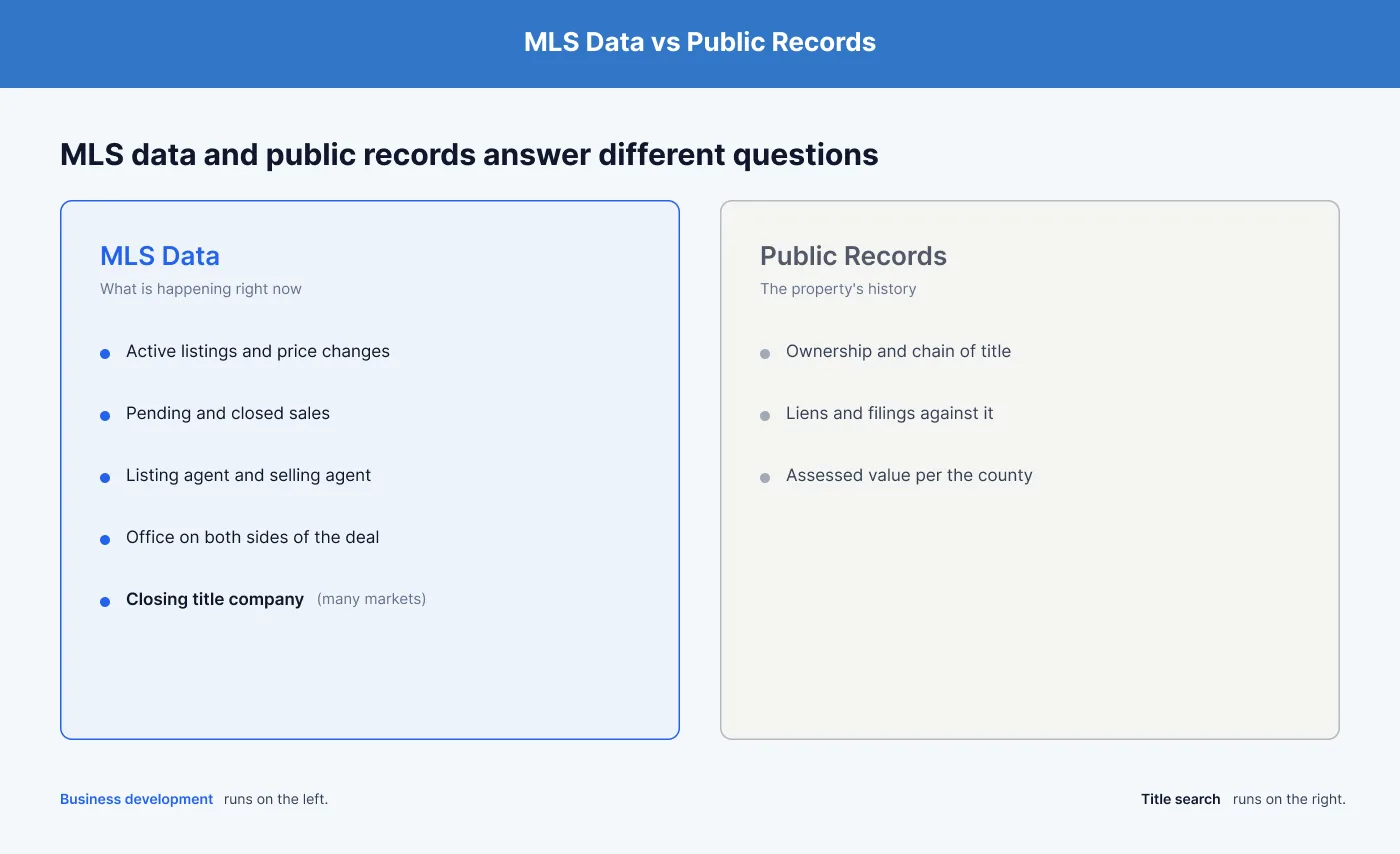
MLS data shows you what is happening right now. Which homes are for sale, which prices have changed, which sales are pending, which ones just closed, who listed the home, who sold it, which office they work for, and in many markets, which title company closed the deal.
Public records show you the history of the property. Who owns it, what is filed against it, and what the county says it is worth.
Your title search needs public records. Your sales team needs MLS data. The real value shows up when you put the two together.
Why Generic MLS Integration Guides Don't Fit Title Companies
Search for MLS API integration advice, and you get pages written for app developers and brokerages. They cover IDX display, photo galleries, and search filters. Useful, just not for you.
Almost nothing published addresses MLS data integration for title companies as its own discipline. The order pipeline, the escrow desk, county market share, and the agent relationship are all missing from that literature.
What Title Companies Actually Do With MLS Data
The reason MLS data integration for title companies pays for itself has little to do with reporting convenience. It is a revenue engine. Here is what it actually powers. MLS analytics for title insurance works on the sales side of the business, not just the reporting side. Here is what it actually powers.
Catching New Listings From Agents You Already Know
Your sales reps already have relationships. Over the years they have worked with dozens of real estate agents in their territory, and those names sit in the ERP as contacts they are meant to keep warm. The problem is timing. When one of those agents puts a new property on the market, that is the moment to call. Wait a week, and the order has usually gone somewhere else.
MLS data closes that timing gap. Most title ERPs already store each agent contact's MLS or license ID. That ID is the link. You use it to look up the agent in the MLS feed and check whether they have posted anything new. When a familiar name appears against a fresh listing, the rep is told while the listing is still fresh, instead of finding out after the fact.
This is harder to run than it sounds, and the difficulty is not technical. It comes down to how clean the contact data is. If the license ID in the ERP is missing, mistyped, or belongs to an agent who has since re-registered, the lookup returns nothing, and that agent silently drops out of the process. Both of the title companies we have worked with hit this same wall. Cleaning up the license information in the ERP is usually the first piece of work, because no amount of MLS data integration for title companies will help if the key that joins the two sides is wrong.
Market Reports Your Agents Actually Want
A second use costs very little once the feed is running. Agents need to know how to price a listing. They want to see the average and median list price in a county, what those properties actually sold for, how those numbers differ by property type, and how they've moved over the last few months.
All of that sits in the MLS data you already hold. A title company can build those summaries once, refresh them automatically, and share them with the agents in its territory. It is a fair exchange. The agent gets pricing context they can use with a seller that week, and your reps get a reason to stay in regular contact with the people who send them referrals.
Market Share, County by County
This is the part most title companies do not realize is available. In many MLS markets, the closing record includes the title company that handled the transaction. That means you can measure your own share and your competitors' share using data you do not own.
ALTA publishes industry premium volume and underwriter market share, and reported 4.5 billion dollars in title insurance premiums in the second quarter of 2025. Helpful for context, but reported at the underwriter and state level. It will never tell a regional agency how it did in one county against the three agencies it competes with locally. A title company market share report built on MLS closings will. That is the difference between reading the industry and reading your own market.
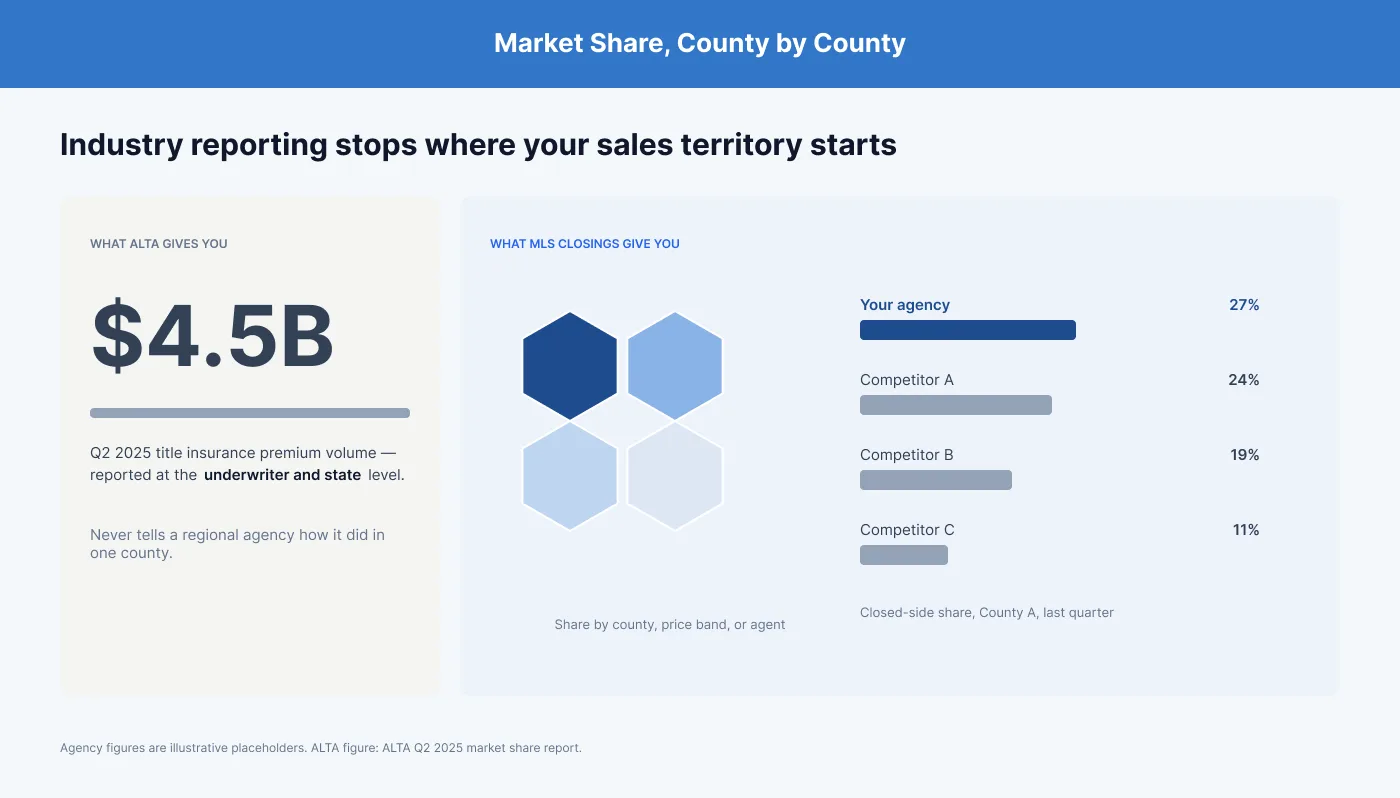
Once MLS data integration for title companies is live, you canmeasure market share by county at whatever grain your sales territory actually uses.
Agent Targeting and Movement Tracking
Your customer is the agent. NAR found that 91 percent of sellers used a real estate agent, matching the highest share on record, while for sale by owner fell to 5 percent. Almost every file you will ever open comes through an agent.
MLS data ranks those agents for you by closed volume, by county, and by price band. It also enables agent movement tracking, which is the most underused signal in title data. Agents change firms constantly, and they take their listings and their client relationships with them. If a top producer in your best county moved offices last month, that is a warmer call than any list you could buy. Good agent targeting and reporting turns cold calling into a ranked queue, which is why MLS data integration for title companies belongs to sales as much as to IT.
How MLS Data Reaches Your Warehouse: The Reference Architecture
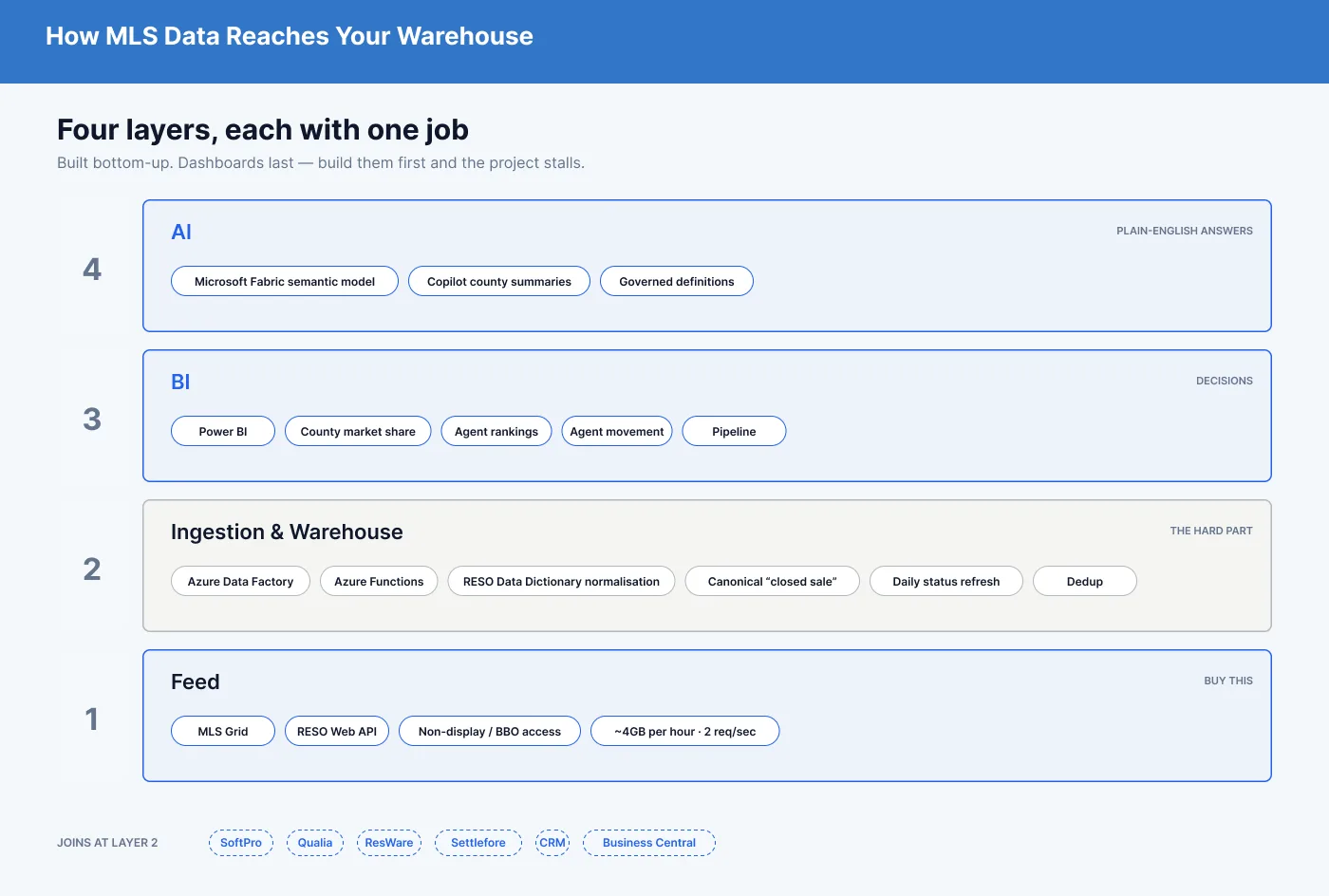
The shape of MLS data integration for title companies is straightforward to describe and hard to build. A title company MLS feed travels through four layers: feed, warehouse, BI, and then AI on top. Each layer has one job.
Licensing the Feed: MLS Grid, RESO and Access Types
Nobody should be negotiating 484 separate agreements, which is why aggregators exist. MLS Grid, for example, gives you one license and one RESO Web API endpoint across dozens of MLSs, with the data already normalized to the RESO Data Dictionary. That is why MLS Grid API integration has become the practical default for multi-market operations.
Access type matters more than the endpoint, and it is where MLS data integration for title companies actually begins. IDX and VOW cover consumer-facing displays. Internal analytics is a different category, usually handled as non-display or Broker Back Office (BBO) use. Sort that out in the contract before anyone writes code.
Ingestion, Normalization, and the Warehouse
Next, you need something to run the pull on a schedule, handle failures, and land the data somewhere queryable. In our work, this has typically been an Azure Data Factory pipeline with Azure Functions doing the shaped extraction, writing into a governed real estate data warehouse.
Normalization is the quiet part of the job, and it absorbs most of the engineering effort in MLS data integration for title companies. Even with RESO compliance, statuses, property types, and office identifiers drift between markets. Someone has to decide what your canonical "closed sale" is and defend that definition across every feed. A proper title data warehouse is where those decisions live.
From Warehouse to Dashboards and AI
Dashboards only make sense at this stage. Build them first, and the project stalls. Build them last and MLS data integration for title companies actually works. A Power BI real estate dashboard sitting on clean data can show you your share in each county, which agents close the most deals, which agents have changed offices, and what is coming up in your pipeline.
That is the kind of report your sales team will open twice a week. This is the layer people mean when they talk about MLS analytics for title insurance, and it only holds up when the warehouse under it is clean.
The AI layer sits above that. With MLS and order data unified under one semantic model, Copilot can produce a plain English county summary for a sales meeting instead of someone rebuilding the same slide every month. That only works because the model underneath is governed. Ask your data in plain English, and you get a good answer only when the definitions are settled first, which is whyconversational BI for title insurance is an architecture project, not a chatbot project.
The Operational Reality Nobody Puts in Writing
Getting the data is roughly the easy twenty percent of MLS data integration for title companies. The harder part shows up later, once the feed is live and running every day.
Take a recent build for a real estate insurance and closing services client. Before any MLS Grid integration existed, their team was doing all of this by hand. Two days a week, someone logged into several MLS websites, downloaded listing and agent files, and stitched them together in spreadsheets. Once we replaced that with an automated daily pull, the company got back more than 72 man-hours a week. Getting to that point meant solving the three problems below.
API Rate Limits and Backfill
Feeds have ceilings. In ourMLS Grid and Azure build, the practical limits were about 4GB of data per hour and two requests per second.
That ceiling shapes how you plan the load, not whether you can do it. The work happens in two phases.
The first phase is replication. You copy the full history you need from MLS Grid into your warehouse, filtered by originating system so each MLS comes across cleanly. This is the heavy part. Depending on how many markets you cover and how far back you go, it can run for days rather than hours.
Once that history is in place, the pipeline switches to incremental mode. From then on, each run pulls only the records that changed in the last 24 to 48 hours, using the same originating system filter. The daily volume drops sharply, and the feed stays current without touching data you already hold.
The rate limits sit underneath both phases. They are not a blocker. They are a planning input. You size the replication run around them, schedule it so it does not collide with the daily incremental pull, and build in retries for the moments you brush against the ceiling.
Stale Listings and the Closed-Only History Gap
The first issue belonged to the old manual process. Because downloads happened weekly, expired and off-market listings sat in the reports for days after they stopped being real. Those dead listings kept counting toward agent totals, office totals, and title company totals, so the numbers drifted further from the truth every week. The daily incremental load fixes this directly. Statuses now update every 24 hours, so a listing that expires on Tuesday is marked expired on Wednesday, and nothing stale survives long enough to distort a report.
The second issue is different. It is not something you fix with better engineering, because it is a limit on what the feed carries. For some markets, the historical data available through the API covers closed properties only. You can see what sold, but you cannot reconstruct what was sitting in the pipeline two years ago. That matters if you want to compare this year's pending volume against the same period last year. The honest answer is to know the gap exists, tell your reporting users where history starts, and build forward from the day your pipeline goes live so the record improves over time.
Neither of these is a coding problem. One is a refresh cadence decision, and the other is a scoping decision you make before anyone builds a dashboard on top.
Daily Refresh Fragility and Dedup Across Hundreds of MLSs
Markets overlap. The same property can appear in two feeds with two identifiers and two slightly different sale prices. Without MLS data deduplication rules, you double-count closings, and double-counted closings destroy the credibility of a market share number in one meeting.
Refresh is fragile in a related way. One late or malformed source can hold up the whole load, and a dashboard showing yesterday's data without saying so is worse than none.
Rate limits, backfill, and stale listing pollution are exactly where MLS data integration for title companies stalls. We built this for a real estate insurance and closing services client on MLS Grid and Azure, cutting more than 72 manual hours a week and making market share and agent dashboards people trust. If you are hitting these walls, let's review your pipeline.
The Enterprise Wall: Unifying MLS With ERP, CRM and the Ledger
This is the point where MLS data integration for title companies becomes more than a data feed. On its own, MLS data tells you about the market. It starts telling you about your own business when it sits in the same reporting layer as everything else you already track.
The practical version of this is simpler than it sounds. You are not wiring MLS records into SoftPro, Qualia, or ResWare. You are bringing the MLS data into Power BI and putting it side by side with the data your teams already work with, such as your sales rep coverage, your customer and agent contact lists, and your own closing records. Once those sit in the same model, the questions change. Which of the top agents in this county are already mapped to one of our reps? Which high-volume agents are not in our contact list at all? Which reps cover territories where our share is slipping?
Those answers come from the reporting layer, not from a connection between systems. That is why the design work goes into the model that holds them together, making sure every source agrees on what counts as a property, an agent, and a closing.
Why Point Integrations Don't Scale
Each new source added one at a time brings another schema, another refresh window, another compliance relationship, and another way for the morning load to fail. Business logic ends up copied into every report, and two dashboards start disagreeing about last month's closings. There is no way to reconcile them because there is nothing underneath to reconcile against.
Governance and Analytics-Use Licensing
Licensing is not only about how you got the data. It also governs what you may do with it and who may see it.
Display rights for a public website are a different question from internal analytics rights. Non-display use has its own terms, and those terms vary by MLS. Layer on row-level security so a loan officer sees their territory, and a manager sees the region, and you are running a real governance model. Governance is the least glamorous part of MLS data integration for title companies, and the part auditors ask about first. It is a contract question before it is a technical one.
Build vs Buy vs Aggregate: A Decision Framework
Three paths to MLS data integration for title companies exist, and the right one depends on scale and on what you want out of the data.
Direct MLS integration. Negotiate and connect to each MLS yourself. Reasonable below roughly ten source MLSs if you already have data engineering capacity. Beyond that, the compliance and maintenance load compounds.
Aggregator plus your own analytics. One license, one RESO-compliant API, many markets.Constellation Data Labs puts the crossover where an aggregator wins somewhere between ten and twenty-five MLS sources, which arrives earlier than most title firms expect. This is the default for almost every multi-market operation.
Canned market share tool. Fast, low effort, and fine if all you need is a periodic market snapshot.
The limit of the third option is worth stating plainly. A packaged tool can report on the market. It cannot help you with advanced market analysis like listing demand and supply, days of inventory left, etc. Analysis will be descriptive, and without detailed data, creating insights is very difficult. So it cannot tell you which agents send you files and which send them to a competitor, which is the question that changes what your sales team does on Monday. Buy the access. Build the analytics. That is the whole rule, and it is why serious MLS analytics for title insurance ends up as an in-house asset rather than a subscription.
That is the reasoning. If you want the map for your own environment, book a 30-minute MLS-to-insight architecture review. A NeenOpal architect will look at your feed, your warehouse, your title ERP, and your reporting, and tell you what to buy, what to build, and where the value actually is.
Frequently Asked Questions
1. Is MLS data the same as public records?
No. MLS data shows current listings and recent sales, including status, price, and the agents involved. Public records show ownership, liens, and tax information. A title operation needs both, joined in one place, because search runs on public records while business development runs on MLS activity.
2. Do title companies need an IDX or VOW license to use MLS data?
It depends on what you are doing with it. IDX and VOW govern consumer-facing display. Internal analytics is usually a non-display or broker back-office matter with its own terms. Any honest scoping of MLS data integration for title companies starts with the access type, not the endpoint, and the terms differ by MLS.
3. How do title companies measure market share with MLS data?
In many markets, the MLS records which title company closed each property, so share can be computed by county, by price band, or by agent. The catch is data quality. The number is only trustworthy when statuses refresh daily, and overlapping feeds are deduplicated first.
4. What are MLS Grid and RESO?
RESO is the standards body behind the Data Dictionary and the RESO Web API that modern feeds use. MLS Grid is a RESO-compliant aggregator that provides one license and one OData-based API across dozens of MLSs, which replaces maintaining a separate connection per market.
5. Can MLS data integrate with SoftPro, Qualia or ResWare?
Yes, through a warehouse layer rather than a direct connection. MLS records land alongside data from your title production system, and the two can be matched on realtor license information. The join is the hard part, not the feed, since matching license numbers depends on cleanliness of data in the title production system.
6. How is MLS data kept current and deduplicated across hundreds of MLSs?
An aggregator normalizes fields to the RESO Data Dictionary, then your pipeline refreshes status daily and applies dedup rules where markets overlap. Rate limits shape the design, since a ceiling near 4GB per hour and two requests per second forces staged, filtered backfill rather than bulk loads.
7. Should a title company build its own MLS pipeline or buy a market share tool?
Buy the data access, and build the analytics if you need MLS joined to your own orders. A packaged tool cannot measure your performance against your pipeline because it cannot see your pipeline. For most regional and mid-market firms, MLS data integration for title companies delivers its real return at that join, not at the feed.

