


The idea of using Artificial Intelligence (AI) in title insurance is already making big moves in the industry. These companies are automating escrow workflows and other parts of title insurance activities to move away from the traditional and manual processes of analyzing the property or ownership records of real estate.
A study reported that nearly 90% of title and escrow professionals are harnessing at least one AI tool, serving as a key advantage when deeply integrated into the workflows.
Well, the role goes beyond workflow automation. This is because it not only automates the workflow part of transaction processing, but it also helps in understanding the business itself. For instance, the conversational AI agents act as direct data-warehouse query agents who ask questions about the various aspects of the business to build reports that, in turn, help companies make wise decisions.
In 2026, figuring out the gap between the two layers of title insurance is where the distinction persists.
This blog covers five main AI use cases for title companies, including a proven solution we built at NeenOpal using Microsoft Copilot and Microsoft Fabric.
What AI in Title Insurance Actually Means in 2026: Two Layers, Not One
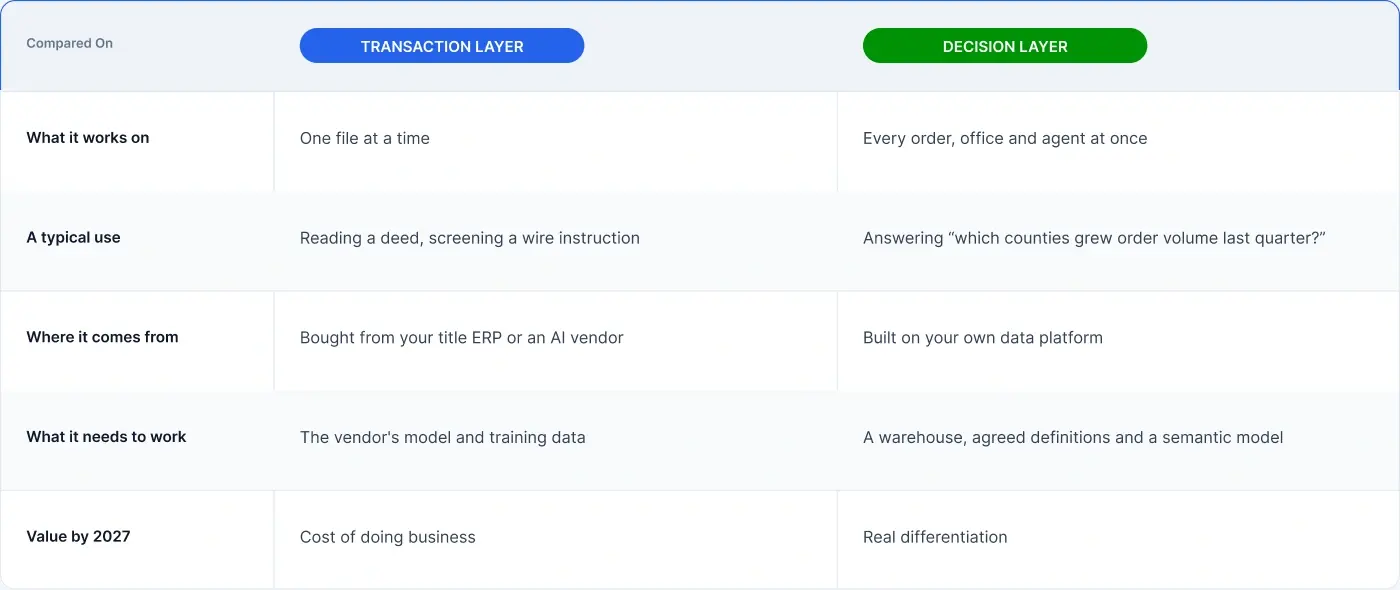
AI in title insurance operates on two distinct layers. The transaction layer automates work inside a file. This includes examination support, document extraction, order intake, wire fraud and identity checks, and status updates. The decision layer answers questions about the business by letting AI ask about order volume by county, premium by closer, turn time by segment, market share, and agent performance.
Thus, transaction-layer AI is becoming standard in title insurance. By 2027, it will no longer be a key competitive advantage.
Transaction-Layer AI: Automating Work Inside a File
This is where AI title production tooling sits, and it works. AI can pull details from deeds and legal descriptions through extraction, help examiners spot liens and other issues, and flag suspicious wire instructions.
Decision-Layer AI: Answering Questions About the Business
The second layer uses AI to help title companies understand what is happening across their business. Instead of using AI only to process documents or automate tasks, companies can use it to work with the data already stored across their systems.
For example:
- Which counties generated the most orders this quarter?
- Which sales reps are growing premium volume?
- Where is turn time increasing?
- Which offices consistently miss their guaranteed closing dates?
- Which agents brought the most profitable business?
- How much market share did we gain or lose in a county?
- Which agents moved between brokerages, and what value moved with them?
This is the point where AI in title insurance lifts your view from the file level to the business level, using data you already collected.
Transaction-Layer vs Decision-Layer AI: A Side-by-Side Comparison
Adoption Is Near-Universal, Advantage Is Not
AI in title and escrow has crossed the adoption threshold. Qualia’s 2025 State of AI in Title & Escrow report found that nearly 90% of respondents use at least one AI tool. The same study found that 86% were neutral to very optimistic about AI changing their jobs over the next three to five years.
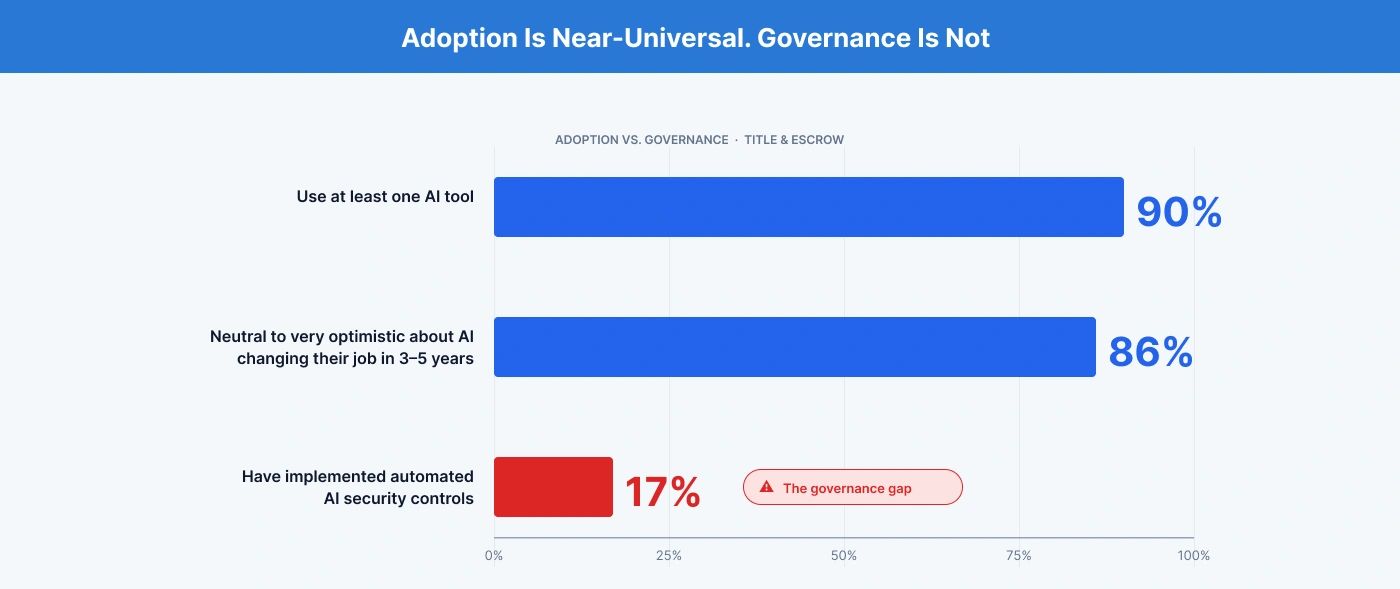
This proves AI in title insurance has become a new normal. While the edge now belongs to the companies whose data answers real questions.
What the Title and Escrow AI Adoption Numbers Actually Measure
Adoption surveys count how many people are using a tool. How deeply that tool sits inside the daily work is a separate question and a far more useful one. A sales representative using a chatbot means one person found a use for AI. Whether the whole sales team can ask about orders, premiums, customer performance, or market share and get an answer on the spot is a structural question about how your data is arranged. One is a person trying a tool. The other is a company that answers its own questions.
There is a second gap sitting underneath the adoption numbers, and it is governance. That gap pointed out in Qualia’s 2025 survey, stating that only 17% of organizations have implemented AI security controls, proving that adoption is moving faster than regulatory controls.
Five AI Title Production Use Cases Already Paying for Themselves
The current AI title production market already has several practical use cases. The first four are the industry's state of play. The fifth is ours.
AI-Assisted Title Search and Examination
AI models read commitments, deeds, and legal descriptions, surface encumbrances and liens, and draft exception language for the examiner to approve or reject. That turns the slowest part of the file into a review task rather than a research task, and the examiner keeps both the judgment and the liability where they belong.
The way to get value from it is to measure the right thing. Pair document-level AI with that kind of check, and you get a faster commitment you can still stand behind.
Order Intake and Title Document Data Extraction
Extraction accuracy on a clean page is high and rising. AI can identify names, addresses, dates, property details, and other fields from documents and reduce manual re-keying. But the difficult part often starts after extraction. A value can be read correctly and still land in the wrong ERP field, so the fix is to map those fields deliberately and check them against the system of record rather than trusting a document-level accuracy score. Judge AI title production on what ends up in your ERP, and the intake gain holds up all the way downstream.
Wire Fraud Detection and Identity Verification in Escrow
The FBI’s Internet Crime Complaint Center logged 12,368 real estate fraud complaints and $275.1 million in losses in 2025, with business email compromise adding $3.04 billion across all sectors. AI-powered wire fraud prevention in real estate works by reading every message, payoff statement, and change request against the pattern of a normal file, then surfacing the outliers in seconds. Stopping one incident saves the weeks of man-hours that recovering a diverted wire demands.
Automated Status Communication for Title and Escrow Customers
Customers want to know what is happening with their transaction. AI can automate routine updates based on order status, reducing the amount of time employees spend answering questions such as whether a search is complete, whether a closing date has changed, or whether additional information is required. The same setup can push AI alerts inward, telling a rep when an order goes overdue, a deadline is approaching or a file changes stage, so nobody has to open a dashboard to check.
Conversational AI in Title Reporting: County Summaries and Plain-English Querying
Here, we will learn from NeenOpal’s use case. We built a Copilot feature for a client inside their Microsoft Fabric setup. Copilot connects straight to the main Fabric layer, where every business definition and calculation rule already lives. That single connection does the heavy lifting: everyone who asks a question works from the same definitions, so the same question returns the same answer for every person in the company.
The feature itself is simple to use. A user types a question in plain language. How many files were closed in the Texas branches last month, which agents sent the most orders this quarter, and how turn time moved since January. The analysis comes back in under five minutes. That covers all the small, one-off questions that used to need a brand new report each time, and it keeps the reporting queue free for the work that truly deserves a dashboard.
The principle behind it stays useful: an AI feature performs as well as the layer it sits on. Build it on your semantic model, and every answer inherits the same logic.
Decision-Layer AI: Asking Your Title Data in Plain English
Conversational BI on title data means asking a question in ordinary language, such as “which counties grew order volume last quarter,” and getting a governed answer without filing a report request. The question hits a semantic model holding your definitions of "order," "premium," "closed file," and "revenue," so the answer is the same however it is asked. This natural language query title data capability is half of AI in title insurance that no vendor can sell you.
What Conversational BI Looks Like on Title Insurance Data
The need is already there. At one client, employees kept asking for reports that didn't exist, even though the data was already in the system. You can't build a new report for every question. That's where conversational analytics helps. People can simply ask questions like "What's the premium by closer?" "Which counties had the most orders?" or "Are we meeting our promised closing dates?"
Why Conversational BI Replaces the Ad Hoc Report Queue, Not the Examiner
Examiners still rely on judgment and remain responsible for their decisions. AI is more likely to replace repetitive reporting work, like rebuilding the same county summary every month or handling report requests that turn a five-second question into a three-day wait.
Why AI Answers Come Back Wrong: The Data Foundation
AI in title insurance rarely fails at the model layer. It fails at the data layer, on inconsistent definitions, on systems that were never joined, and on history nobody preserved. Three problems account for most of it.
Problem 1: When the Same Title Field Means Two Different Things
One order, two statuses: cancelling and cancelled, each with its own date. Operations may want to know when the order was finally cancelled, not when cancellation began. That sounds like a small reporting detail. It is not. If every report defines the field differently, the company can produce multiple correct-looking answers to the same question.
In one engagement, every report had its own semantic model and business definitions. Over time, those models became silos. This is why an enterprise semantic model is more important than simply putting AI on top of existing reports. The ERP's flexibility can create another problem. When different branches configure workflows differently, their data may no longer be directly comparable.
Problem 2: Title ERP, CRM and Financial Data That Were Never Joined
A title company runs on three core systems: the production ERP, a ledger such as Dynamics 365 Business Central, and a CRM such as HubSpot. In one case, the ERP exposed no APIs, so a direct CRM-to-ERP integration was abandoned in favour of pushing cleaned data from Fabric into HubSpot. The data needed to be transformed and joined before it could support cross-functional analysis.
Problem 3: Order Status History Nobody Modelled
Transitions like "cancelling" to "cancelled" are changes over time. If the data model only stores the latest state, historical questions become difficult or impossible. This is where concepts such as snapshots and historical dimensions become useful. An AI model cannot reconstruct history that the data platform never preserved.
The Sequencing Rule: Title Insurance Data Warehouse to Semantic Model to Governed AI
The most important architecture rule for title insurance data warehouse projects is sequencing.
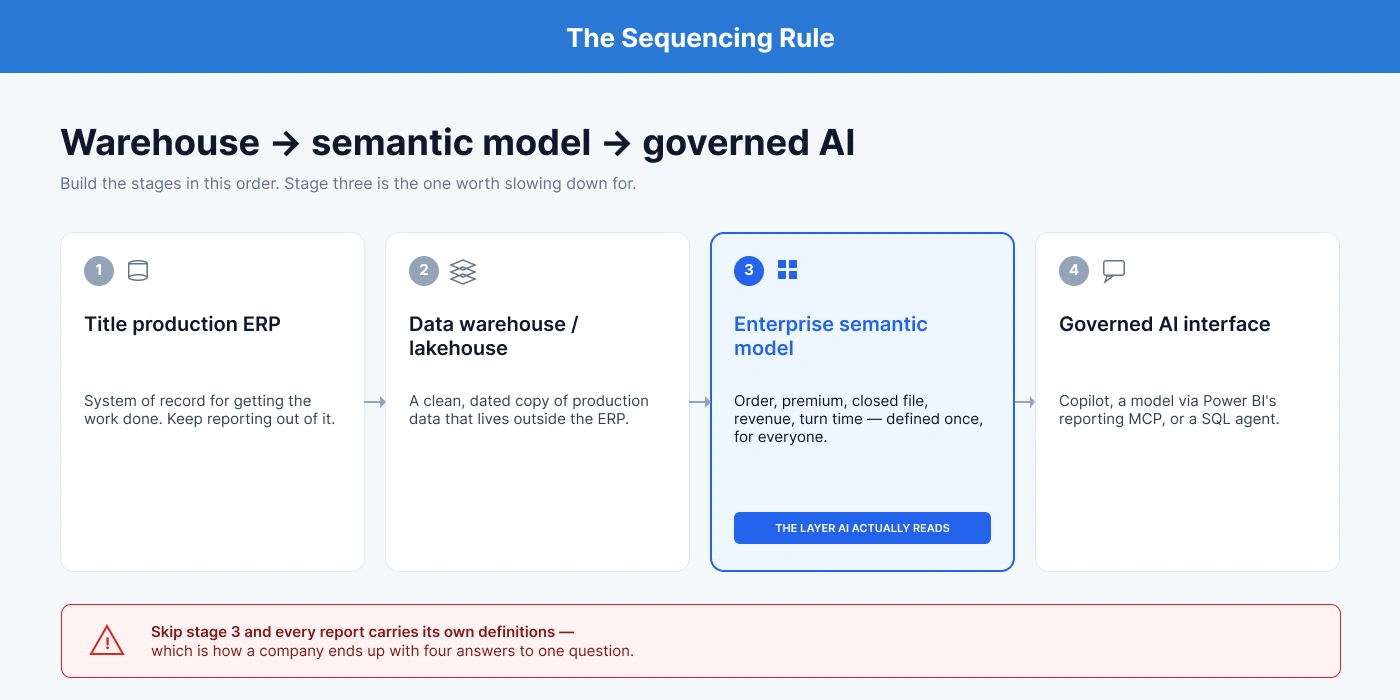
- Title production ERP. Your system of record for getting the work done. Keep reporting out of it.
- Data warehouse or lakehouse. A clean, dated copy of production data that lives outside the ERP, where a problem like "cancelling" versus "cancelled" gets fixed once rather than in every report.
- Enterprise semantic model. One place where every business definition lives: order, premium, closed file, revenue, turn time, timeliness. Agree each one once, and every number agrees with every other number.
- Governed AI interface. Copilot, an outside model connected through Power BI's reporting MCP, or a SQL agent, with cleaned data pushed back into the CRM so sales works from the same figures.
Stage three is worth slowing down for, because it is the layer AI actually reads. An enterprise semantic model holds the rules: what counts as a closed file, when premium is recognized, and how turn time is measured.
Build it once and every report, dashboard, and AI answer inherits the same logic. Skip it, and each report carries its own version, which is how a company ends up with four answers to one question.
ROI: Cost Per File vs Revenue Per Agent
Every ROI figure published about title insurance automation 2026 measures the same thing: the cost of processing one file. Cycle time down 35-50%. Order entry down 70-85%. Those numbers come from the vendors selling the software, so read them as sales claims, not neutral benchmarks. Not one of them tells an owner whether the firm won more orders, which is what buyers of AI in title insurance actually get judged on.
The Efficiency Case for Title Automation, and What It Actually Measures
Time and staff per file is a fair yardstick, and it is the right one for the transaction layer. It also has a ceiling. You can shave minutes off every order and still not know which counties are growing, which agents are drifting to a competitor, or where the next hundred orders are coming from.
So read the efficiency numbers as the floor of the business case rather than the whole of it. Faster files are a real win. Faster files plus a clear view of where revenue comes from is a different order of return.
What to Ask Before You Buy Any AI in Title Insurance
Evaluation checklists for AI in title insurance are usually written from the sales side. This one is written from the data side, so each question comes with the answer worth waiting for.
- What does this assume about our data? A strong answer names the tables, the definitions and the history the tool needs before it can work.
- Does this read our ERP directly, and what happens when we add a warehouse? You want a vendor who can point at both paths and explain what changes when the warehouse arrives.
- Where is access control enforced, in the report or in the data model? You want it in the model, because that is what an AI interface actually queries.
- How do you handle a field that means two things, like cancelling versus cancelled? Listen for a vendor who asks which date your operations team needs before answering.
- Can it answer a question about last year, not just today? A strong answer talks about history, snapshots and how change over time is stored.
- What capacity or licence tier does this require? Get the tier in writing. Microsoft requires paid Fabric capacity of F2 or higher, or Power BI Premium P1, for Copilot.
- What will you measure to prove this worked, and who owns that number? The answer should name a metric in your business and a person on your side who owns it.
- When your model is wrong, how do we find out? A confident vendor will describe their error handling, review process, and how mistakes surface to your team.
Buy at the Transaction Layer, Build at the Decision Layer
Buy at the transaction layer, where title insurance AI vendors hold title-specific training data you cannot replicate. Build at the decision layer, where the value comes from your unified data and no vendor can see across it. That is how the build versus buy AI title company question resolves, and it returns you to where this started: not which AI to buy, but what would have to be true about your data for any of it to work.
The fastest way to know whether AI will work on your data is to have someone look at your data. A NeenOpal architect will walk your reporting stack, title ERP, CRM and financials, and tell you which of the four stages you are on and what the next costs. Contact us now!
Frequently Asked Questions
1. How is AI used in title insurance?
AI in title insurance works on two layers: transaction-layer automation (examination assistance, document extraction, order intake, fraud checks, and status updates) and decision-layer intelligence (analytics, plain-language querying, and market share and agent intelligence). The first is no longer a differentiator while the second depends on your data architecture.
2. Will AI replace title examiners?
No, because judgment and liability stay with a person. The roles most exposed sit in manual report production: the analyst rebuilding the same county summary monthly and the ad hoc report queue.
3. What data does a title company need before it can use AI?
A clean, dated copy of your production data that lives outside the titled ERP, with order, premium, closed file, and revenue defined once for everyone.
4. Is AI in title insurance compliant and safe to use?
AI can be used in title and escrow, but safety depends on how the system is designed and governed. The biggest risk is not always an AI model producing a strange answer. It can also be an AI interface providing a correct answer to someone who was never authorized to see the underlying information.
5. What is agentic AI in title and escrow?
Agentic AI takes actions on whatever your systems say is true: opening an order, ordering a search, clearing a condition.
6. Can AI read and interpret a title commitment?
Yes. Document AI can extract information from title commitments, deeds, legal descriptions, and related documents.
7. Can I ask my title data questions in plain English?
Yes. With one agreed data model behind it, you can ask something like "which counties grew order volume last quarter" and get an answer without raising a report request.
8. What does AI in title insurance actually cost?
Individual tools run from a few hundred to a few thousand dollars a month per workflow. The higher cost, and the one nobody quotes, is the data groundwork: the warehouse, the modelling, the integrations. That is where most of the budget goes on any project that lasts beyond the pilot.
9. Should we buy an AI product or build on our own data platform?
Buy at the transaction layer, where vendors have title-specific training data you could never build yourself. Build at the decision layer, where the value comes from your own joined-up data and no vendor can see across your ERP, Buy at the transaction layer, where vendors have title-specific training data you could never build yourself. Build at the decision layer, where the value comes from your own joined-up data and no vendor can see across your ERP, CRM, and finances., CRM, and finances.

