

Recognition usually comes a little after the work itself. First there's the migration that goes live on schedule. Then finance and sales see the same numbers for the first time. One day the client simply opens a dashboard and trusts what it says.
That's how this one reached us. NeenOpal is now a Microsoft Fabric Featured Partner, and the work behind it adds up. Our team has put in more than 100,000 hours on Azure services. We've delivered over 1,000 Power BI dashboards and deployed more than 10 Fabric and data workflows for clients. More than 40 Microsoft-certified professionals did that work.
Anyone choosing a Fabric partner ends up asking the same thing sooner or later. Have they done this before, or will we be their test case? Those numbers answer that early. Below, we'll walk through what's behind them and why it matters for your project.
What a Microsoft Fabric Featured Partner Actually Is
A Microsoft Fabric Featured Partner is a services firm that Microsoft highlights for real, hands-on experience with Microsoft Fabric. Microsoft is vouching that the team knows the platform and has already delivered results with it.
Plenty of firms say they do Fabric work. The featured listing shows which ones can prove it.
How Microsoft Awards Featured Partner Status
Partners do not get it just by signing up. Microsoft looks at:
- Certified people. Consultants who have passed Microsoft’s Fabric exams, such as Fabric Analytics Engineer and Fabric Data Engineer.
- A delivery track record. Fabric projects are running in production, not pilots on a slide.
- Customer outcomes. Proof that those projects solved a real business problem.
- Marketplace presence. Published offers that customers can find and review.
For us, becoming a Microsoft Fabric Featured Partner builds on credentials we already hold. These include the Analytics on Microsoft Azure Specialization and Solutions Partner designations in Data & AI (Azure), Digital & App Innovation (Azure), and Infrastructure (Azure).
Why This Recognition Matters for Your Business
What this recognition really does is lower the risk of your next big data decision. When you pick a Microsoft Fabric Featured Partner, you pick a team that has already gained experience across complex implementations and knows what it takes to get Fabric right.
That shows up in five practical ways:
- Faster time to insight. Proven patterns mean useful reports in weeks, not quarters.
- Trusted data foundations. One governed copy of the data means finance and sales finally see the same number.
- A simpler setup. Fewer tools to license, patch, and connect, which cuts software and support costs.
- Stronger governance. Access rules, lineage, and sensitivity labels are set early, so audits hurt less.
- Confidence in AI. AI only works when the data under it is clean and well organized.
That last point deserves a closer look. Gartner predicts that organizations will abandon 60% of AI projects that are not supported by AI-ready data by 2026. The same research found that 63% of organizations either lack or are unsure they have the right data management practices for AI. Working with a Microsoft Fabric Featured Partner helps close that gap before the AI budget is spent.
“Microsoft Fabric is reshaping how organizations manage, unify, and analyze data. Being recognized as a Fabric Featured Partner validates our ability to help enterprises simplify their data landscape, accelerate analytics adoption, and build AI-ready foundations using Microsoft Fabric,” said Pavel Gupta, Co-Founder, NeenOpal.
How NeenOpal Delivers Value on Microsoft Fabric
Good projects rarely start with “Which platform should we buy?” They start with “Why does our month-end close take nine days?” So we learn the business problem first and choose the platform approach second.
As a Microsoft Fabric Featured Partner, we deliver our Microsoft Fabric consulting services in three stages.
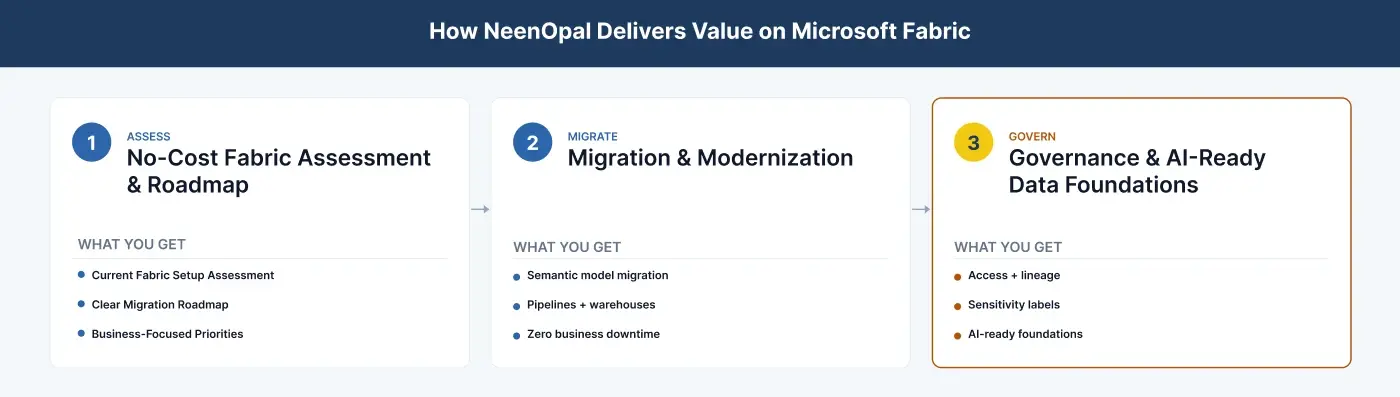
No-Cost Fabric Assessment & Roadmap
This first step is on us. We offer the Fabric assessment free of charge, so you can see the full picture before you spend anything. We take time to understand your current setup. That covers where your data comes from, how it flows, which reports people actually use, what you're paying for in licenses, and where things keep getting stuck. You walk away with a plan that's easy to follow. It shows what's worth moving to Fabric, what's fine where it is, and what should go first. Each step is tied to a business result, so nobody in leadership has to guess what the budget is buying.
Migration & Modernization
Moving to a new platform shouldn't mean your teams lose their reports for a week. Our Microsoft Fabric migration services bring your pipelines, warehouses, and Power BI content into Fabric while people keep working as usual. One client had to move its semantic models from one Microsoft tenant to another. Hundreds of employees opened those reports every day so they would have noticed any downtime quickly. Breaking them wasn't an option. You can read how we pulled it off in our Microsoft Fabric migration case study. Because the client also wanted a stronger base for the future, we brought in our cloud modernization and data engineering services as part of the same project.
Governance & AI-Ready Data Foundations
We set up data governance from day one: who can see what, where each number came from, and how sensitive data is labeled. That is what makes your data AI-ready and your Copilot answers worth trusting.
As a Microsoft Fabric implementation partner, we also bring years of Power BI consulting services to every project. This matters because Power BI and Microsoft Fabric work best when they are planned together, not bolted on later. Our Analytics on Microsoft Azure Specialization, earned through an independent audit, backs that up.
Not sure where to begin? Ask us about a free Fabric readiness assessment. Talk to a Microsoft Fabric expert.
The Difference Customers Experience
What customers remember is how their week changes. When clients work with us as a Microsoft Fabric Featured Partner, this is what tends to shift:
- Fewer tools to maintain. Several separate services often shrink into one platform and one bill.
- Faster dashboards. Reports that took minutes to load open in seconds because they read from one well-tuned semantic model.
- Governed self-service. Business users build their own reports without creating a new version of the truth each time.
- AI projects that ship. With clean, labeled data in place, Copilot pilots move from demo to daily use.
The common thread is trust. When people trust the numbers, they stop arguing about them and start acting on them. That is the real return on a modern data platform, and it is the focus of our enterprise BI consulting work.
Microsoft Fabric in Plain Terms, and the Problems It Solves
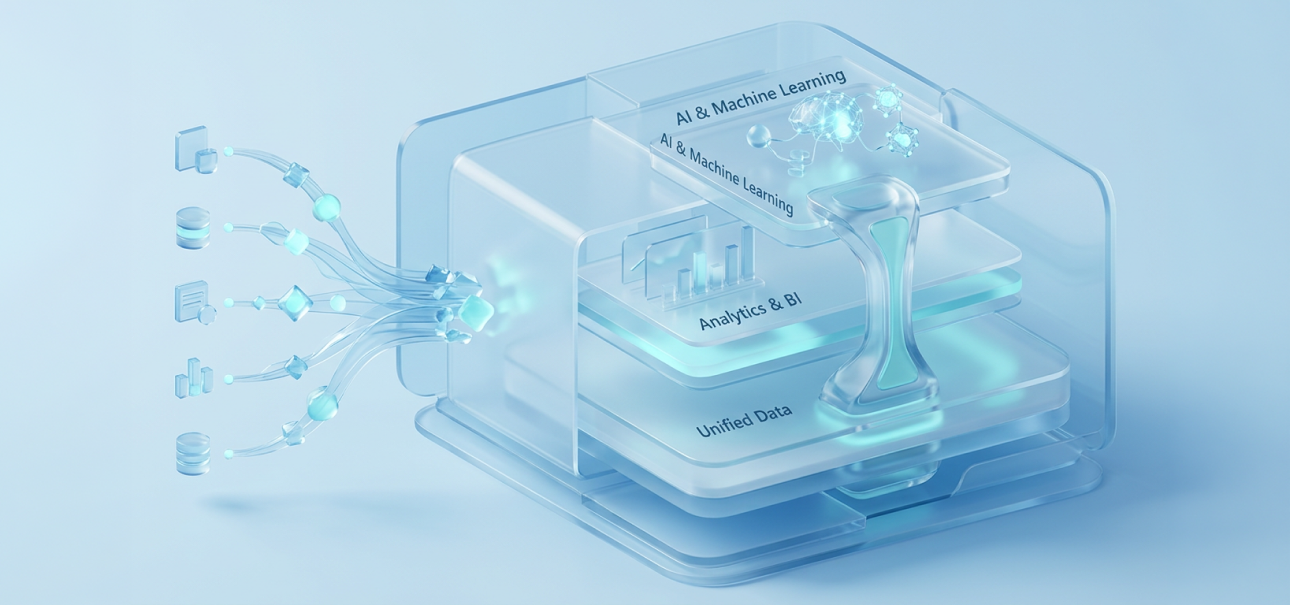
Think of Microsoft Fabric as one house for all your data work. Before Fabric, most companies rented several apartments across town. One tool moved the data, another stored it, a third ran reports, and each kept its own copy.
Fabric brings everything under one roof. It is a unified analytics platform built on a single storage layer called OneLake. On top of OneLake sit the tools most data teams need:
- Data Factory for moving and shaping data (the ETL/ELT work)
- Lakehouse and data engineering for storing raw and cleaned data side by side
- Data warehouse for fast, structured queries
- Real-Time Analytics for data that streams in every second, like sensor or payment feeds
- Power BI for the dashboards and reports people actually open
- Copilot in Fabric for asking questions and building content in plain English
Because every tool reads from OneLake, you stop copying data between systems, and one semantic model can feed hundreds of Power BI reports. FFor teams that once juggled Azure Synapse and scattered workspaces, consolidating onto the Microsoft Fabric data platform puts it all in one place.internal link change hojaayega iska
Here are the everyday problems it fixes:
- Data trapped in department silos
- The same pipeline built three times by three teams
- Reports that take hours to refresh
- Conflicting numbers in leadership meetings
- AI tools that cannot trust the data they are fed
Many teams organize their Fabric data with a medallion architecture. Raw data lands in a bronze layer, gets cleaned in silver, and becomes business-ready in gold.
The payoff can be large. A Forrester Total Economic Impact study commissioned by Microsoft found a 379% return on investment over three years for a composite organization using Fabric, along with a 25% lift in data engineering productivity.
Looking Ahead
Being named a Microsoft Fabric Featured Partner is a milestone, not a finish line. Over the next year, we are investing in three areas: deeper use of Copilot in Fabric, agentic analytics where AI agents watch your data and flag issues before anyone asks, and governed AI that stays safe as it scales. We are also building reusable accelerators and frameworks that cut implementation time and risk.
Our promise as a Microsoft Fabric Featured Partner stays simple. Start with your business problem, build on trusted data, and deliver results you can measure.
Ready to see what Fabric could do for your team? Talk to a Microsoft Fabric expert or explore our BI & analytics services.
Frequently Asked Questions
1. What is a Microsoft Fabric Featured Partner?
It's a title Microsoft gives to consulting firms that have actually put Fabric to work for clients. Getting it takes certified people on the team and live projects with results Microsoft can see. A Microsoft Fabric Featured Partner has done more than read the documentation.
2. What does being a Microsoft Fabric Featured Partner mean for NeenOpal's customers?
Mostly, fewer surprises. Our team holds Fabric certifications and has already moved real workloads onto the platform, so the tricky parts of your project are ones we've seen before. As a Microsoft Fabric Featured Partner, we can get you to unified analytics and AI-ready data faster and with less risk.
3. How does Microsoft Fabric relate to Power BI?
Power BI is where your reports and dashboards live, so it's the part most people see. Fabric sits underneath it. It pulls in the data, cleans it, stores it, and controls who can access it. Because of that setup, every Power BI report reads from the same trusted data.
4. Does NeenOpal offer Microsoft Fabric migration services?
Yes. NeenOpal provides Fabric assessment and roadmap, migration and modernization (including semantic model migration), and governance for AI-ready data foundations.
5. How can I verify NeenOpal’s Microsoft credentials?
You can check Microsoft’s partner directory and marketplace listings, review team certifications, and ask NeenOpal for references on workloads similar to yours.

